Published by Oko
Founder, Offshore Pipeline Insight
May 30, 2026.
Subsea Carbon Capture, Utilization, and Storage (CCUS)
is rapidly becoming one of the most important tools in the offshore industry’s energy transition toolkit.
By capturing CO₂ from industrial sources or power plants and storing it permanently beneath the seabed, operators can significantly reduce emissions while repurposing existing infrastructure.
This article explores how subsea CCUS works, the leading technologies, major projects underway in 2026, the critical role of pipeline repurposing, and the challenges that remain.
How Subsea Carbon Capture and Storage Works
Subsea CCUS typically involves three main steps:
- Capture — CO₂ is captured from industrial emissions onshore or offshore.
- Transport — The CO₂ is compressed into a dense phase (liquid or supercritical) and transported via pipeline or ship to offshore injection sites.
- Storage — The CO₂ is injected into deep geological formations (saline aquifers or depleted hydrocarbon reservoirs) beneath the seabed, where it is permanently trapped.
Subsea systems offer several advantages over onshore storage: larger storage capacity, fewer public opposition issues, and the ability to use existing offshore pipelines.
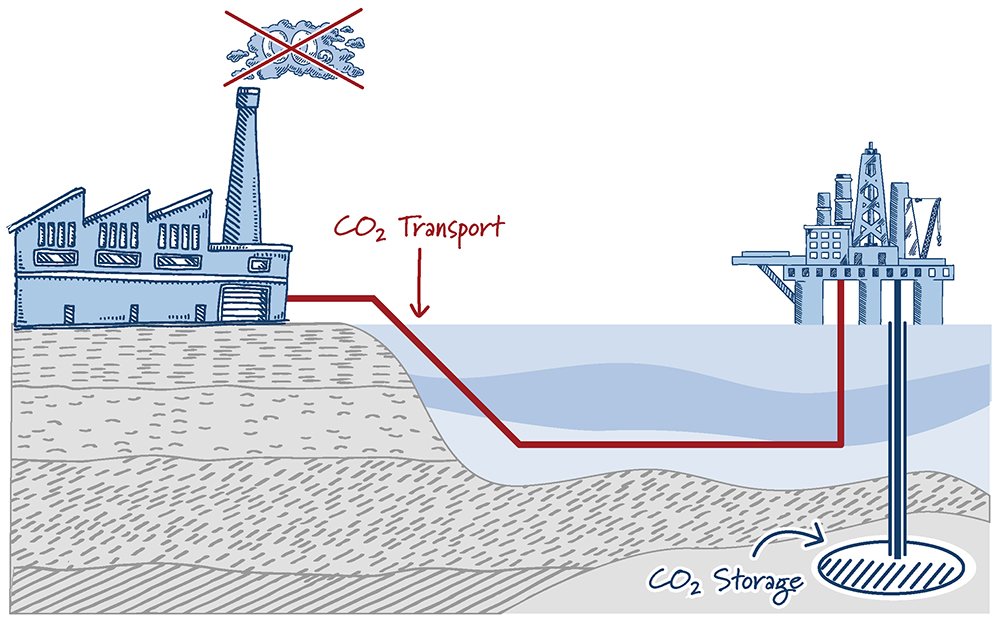
Subsea CCUS Concept — CO₂ transport and injection from onshore capture to offshore storage.
Key Technologies Driving Subsea CCUS in 2026.
Dense-Phase CO₂ Pipelines — Existing gas pipelines are being repurposed for high-pressure CO₂ transport.
Subsea Injection Wells — Advanced well designs with corrosion-resistant materials and real-time monitoring.
Digital Twins & Real-Time Monitoring — AI-powered models track plume migration, pressure, and integrity.
Subsea Processing Modules — Early separation and boosting systems that reduce topside requirements.
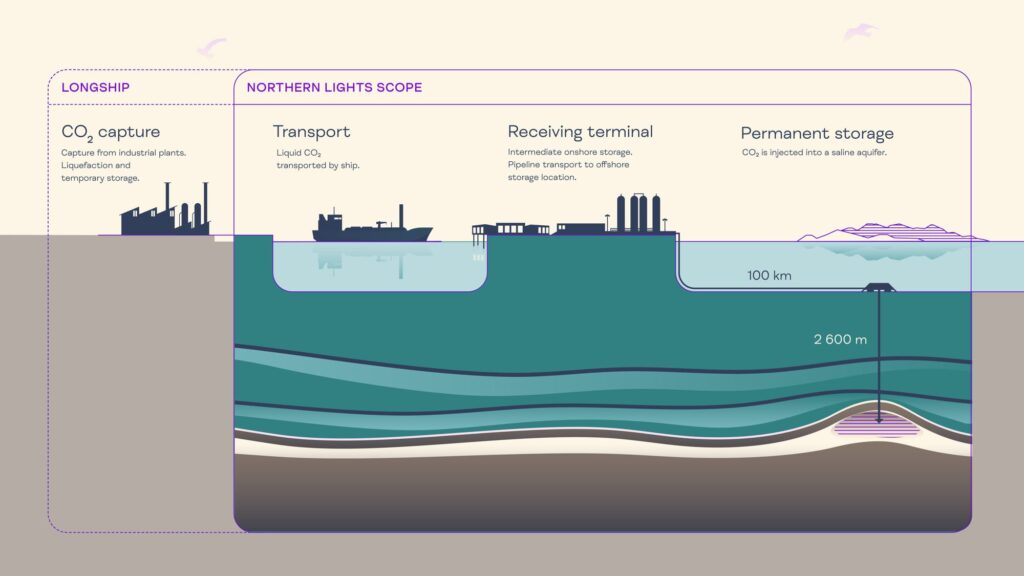
Northern Lights CCUS Project Overview — One of the world’s most advanced full-chain subsea storage initiatives.
Major Subsea CCUS Projects in 2026Northern Lights (Norway)
Equinor, Shell, and TotalEnergies’ flagship project continues to expand.
Liquid CO₂ is shipped from European industrial sites, then transported via pipeline to offshore injection sites in the North Sea.
It is one of the first commercial-scale subsea storage operations.
Greensand Future (Denmark)
A major project repurposing depleted oil and gas fields in the Danish North Sea for CO₂ storage.
It demonstrates how legacy infrastructure can be successfully transitioned to carbon storage.
UK North Sea CCUS Clusters
Multiple operators are actively evaluating repurposing of existing pipelines for CO₂ transport as part of the UK’s net-zero strategy, with strong support from the North Sea Transition Authority (NSTA).
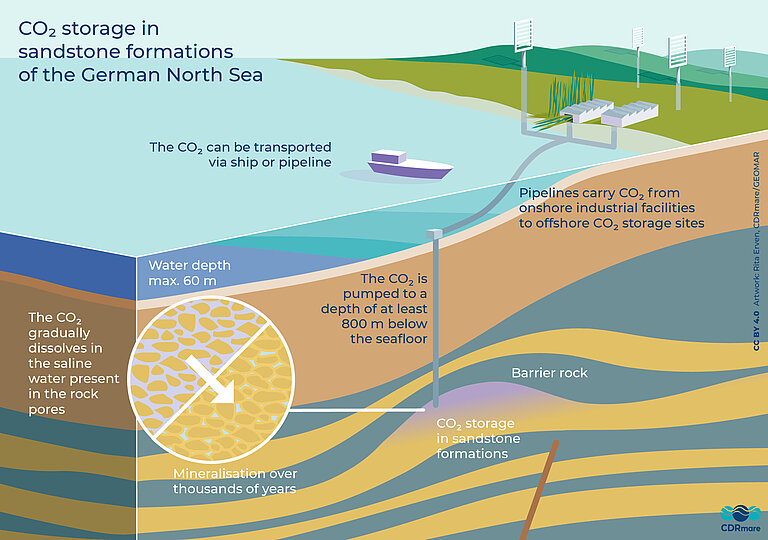
Subsea CO₂ Storage Concept — Injection into saline aquifers beneath the seabed.
The Critical Role of Pipeline Repurposing
One of the biggest cost-saving opportunities in subsea CCUS is the repurposing of existing gas pipelines.
As detailed in our earlier article on Subsea Pipeline Decommissioning vs Repurposing, operators can save 30–60% by reusing infrastructure instead of building new lines.
Key considerations include material compatibility, corrosion management, and detailed integrity assessments.
Challenges in Subsea Carbon Capture
- Corrosion and Material Degradation — CO₂ can be highly corrosive, especially when impurities are present.
- High-Pressure Operations — Dense-phase CO₂ requires robust pipeline design and monitoring.
- Plume Monitoring — Ensuring long-term storage integrity requires advanced seismic and fiber-optic sensing.
- Regulatory and Permitting — Approval processes for subsea storage are still evolving.
Conclusion
Subsea Carbon Capture and Storage is no longer a future concept — it is an active, commercial-scale solution in 2026. By combining pipeline repurposing, advanced monitoring, and subsea injection technologies, the industry is making significant progress toward net-zero goals while maximizing the value of existing offshore assets.
For pipeline and subsea professionals, expertise in CCUS-related integrity management, materials science, and digital monitoring is becoming increasingly valuable.
Related Reading on Offshore Pipeline Insight:
- Subsea Pipeline Decommissioning vs Repurposing
- North Sea Transition Authority (NSTA)
- Maximizing Subsea Infrastructure Efficiency
“Engineers looking to deepen their knowledge in subsea pipeline integrity should check out Subsea Pipeline Design, Analysis, and Installation by Qiang Bai (https://amzn.to/4u7edfH). This book is an excellent reference for understanding the practical applications of digital twins.”