Delfin FLNG 1 has taken a $5 billion FID. The hull will be built in Korea. The gas still has to travel through Louisiana pipe. That is why this project belongs on a pipeline site.
By Oko Immanuel, Founder, Offshore Pipeline Insight
19 September 2026
The United States already exports LNG from the beach. Cameron Parish, Plaquemines, Corpus Christi and Sabine Pass are proof. What the country has not done is liquefy American pipeline gas on a ship and load a carrier in federal waters.
That changes with Delfin FLNG 1.
In June 2026, Houston-based Delfin Midstream took a final investment decision on the first vessel of its Louisiana / Gulf of America scheme. Nameplate capacity is 4.4 million tonnes per year. Project cost is about $5 billion. First LNG is aimed at 2030. The company and its backers describe it as the first floating liquefaction facility in the United States and the largest FLNG project yet sanctioned. A full build-out of three vessels would reach 13.2 mtpa.
This is not a reservoir FLNG like Prelude, sitting on a gas field and making its own feedstock. Delfin is a liquefier. It takes pipeline-quality gas from the U.S. mainland, moves it offshore through existing steel, chills it on the hull, and loads an LNG carrier. If you work pipelines, that sentence is the whole project.
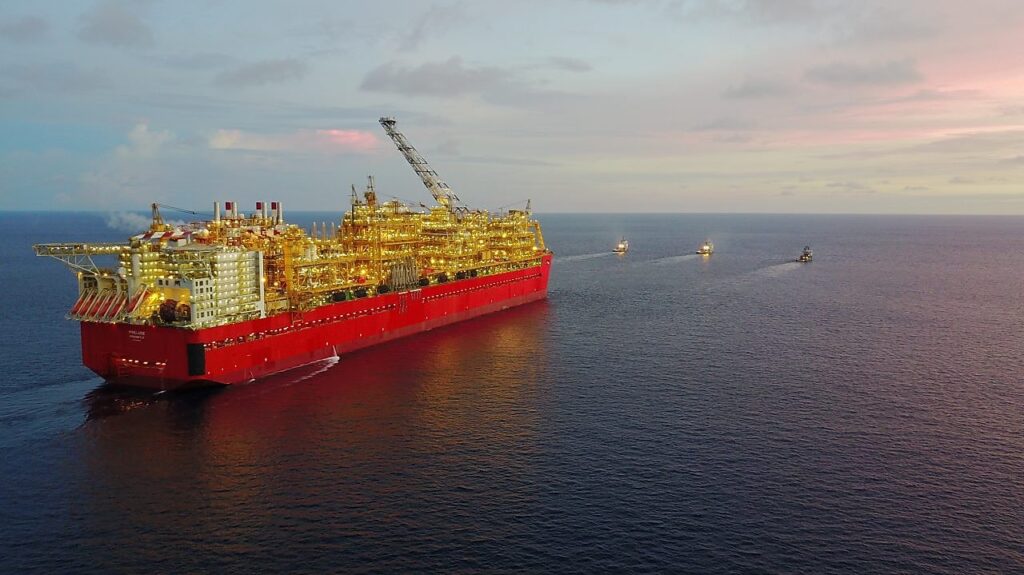
Caption: An FLNG vessel is a liquefaction plant that floats. Delfin’s design is a liquefier, not a production FPSO — feedgas arrives by pipe.
Why FID took more than a decade
Delfin bought the old U-T Offshore System (UTOS) line in 2014 and filed its Deepwater Port application in 2015. MARAD issued the deepwater port licence in 2025. The site is in the West Cameron area of the Outer Continental Shelf, about 40 to 41 nautical miles off Cameron Parish, in water only about 72 feet deep. That is shallow by Gulf deepwater standards. It is deep enough for a permanently moored liquefaction hull and a shuttle carrier.
The delay was not only paper. A pipeline rupture near Holly Beach and Johnson Bayou during pigging in early 2026 pushed the decision. Vitol, which is both equity and the largest offtaker, said publicly that FID would have come earlier without the blast. Delfin spent February testing the integrity of the line that runs from offshore to a termination about one mile onshore near Johnson Bayou — a line that had been out of service and must be brought back under a PHMSA order before it can feed the plant
That is the unfashionable lesson. You can have Samsung, Black & Veatch, Siemens turbines and a BlackRock-affiliated infrastructure fund. If the 42-inch pipe is not fit for service, the FID clock stops.
Who is paying, who is buying
Equity sits with Global Infrastructure Partners (part of BlackRock), Mitsui O.S.K. Lines, Vitol and Diameter Capital. MOL brings the world’s largest LNG carrier fleet. Vitol is both investor and offtaker.
Long-term sales cover most of FLNG 1. Named buyers: Vitol (about 1.4 mtpa, the largest slice), Expand Energy, Centrica and Gunvor. Binding offtake is reported near 90 percent of the first vessel. A Hartree deal was dropped before FID.DOE filings earlier in 2026 put five binding SPAs at 3.3 mtpa before later novations. The commercial structure is vessel-by-vessel, which is how Delfin keeps each FID from depending on a 13 mtpa mega-train.
For readers who follow U.S. gas: Expand Energy is Haynesville and Appalachia molecules looking for a tidewater home. Centrica is a European utility that learned, after 2022, not to depend on a single basin. Gunvor and Vitol are the trading layer that turns a 2030 start-up into a cargo book.
The construction split: Korea builds the plant, Louisiana keeps the pipe
Samsung Heavy Industries will design and build the vessel. Published figures put the yard contract near $2.9 billion. Samsung already has Cedar LNG experience. Black & Veatch has topsides engineering and procurement and the Pricosingle-mixed-refrigerant process that Delfin has used since FEED. Siemens Energy supplies gas-turbine packages. The design is gas-turbine driven and air-cooled for liquefaction and utilities — no giant seawater cooling circuit of the kind that complicates some older FLNG concepts.
Delfin’s own description is useful. Because the vessel receives pipeline-quality feed gas, it does not need the inlet processing train of an LNG FPSO that produces from a reservoir.That is why the company cut an original four-vessel plan to three and still claims the same export job. Less complexity on the hull is more original four-vessel plan to three and still claims the same export job. Less complexity on the hull is more .
The construction calendar is long. Letter of award with Samsung in October 2025, extended in January 2026, FID in June 2026, first drops in 2030. Between those dates sit steel cutting, module integration, tow, hook-up, and the unglamorous work of making UTOS and HIOS ready for continuous high-rate gas.
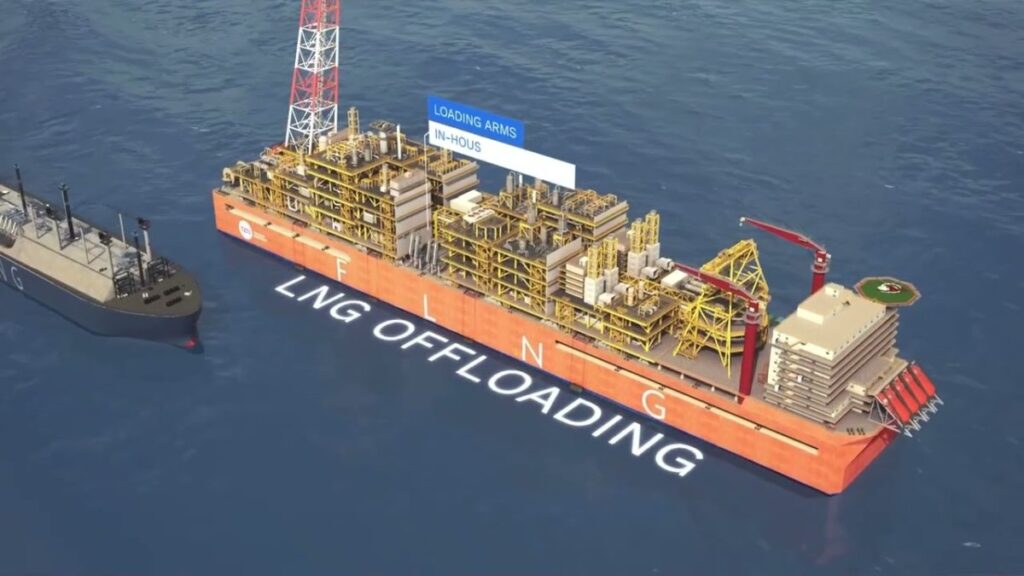
Caption: On paper an FLNG looks like a ship with a plant on deck. In the field it is a hook-up: moorings, risers or pipeline connections, offloading arms, and a carrier on the other side.
The pipeline system is the project
This is the section that belongs on Offshore Pipeline Insight
Delfin LNG LLC owns the UTOS line: a 42-inch offshore gas pipeline that runs about 30 miles from the junction platform at West Cameron Block 167 north to Williams / Transco Station 44 near Johnson Bayou, Cameron Parish. It is the only 42-inch line in that Gulf corridor and was formerly an Enbridge system. From WC-167, gas is designed to move south to the deepwater port on the High Island Offshore System (HIOS) under a long-term lease. A short 700-foot, 42-inch bypass has been discussed to connect UTOS and HIOS and avoid an old platform. Delfin also owns the Grand Chenier pipeline on the nearshore side. Historical FEED language put UTOS at about 2 Bcf/d and Grand Chenier at about 700 MMcf/d. Each 4.4 mtpa hull is roughly 0.6 Bcf/d of feed. Three hulls would want the better part of 2 Bcf/d on a reliable day.
That is brownfield midstream, not a new 200-mile export header. The work is pigging, anomaly digs, coating, tie-ins, meter stations, and PHMSA compliance on a line that has already shown it can fail during a test. Live-line repairs, isolation philosophy and how you keep Station 44 packed while a hull is offline will decide whether 2030 is a real date.
Compare that with Commonwealth LNG or a Venture Global train. Those projects pour new tanks onshore and drag new laterals across the marsh. Delfin spends its capital in Geoje or similar and asks Louisiana’s existing offshore grid to behave like a plant feed. When it works, it is cheaper and faster. When a pig run finds metal loss, the whole FID narrative waits on a weld.
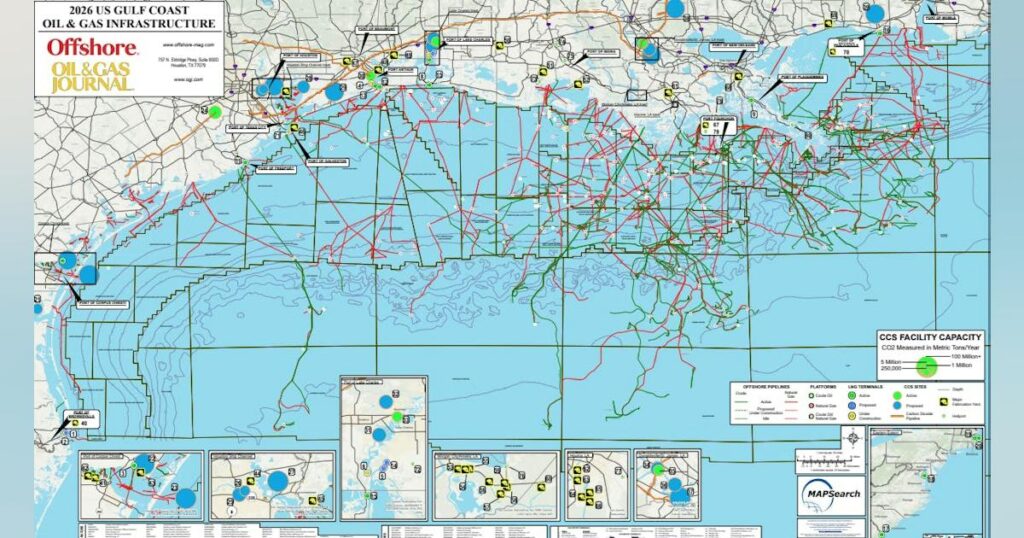
Caption: The Gulf Coast is already a web of oil and gas lines. Delfin does not invent that web. It plugs a liquefaction hull into it about 40 miles off Cameron Parish.
How this sits next to the rest of the U.S. LNG wave
RBN Energy counted Delfin with Commonwealth LNG and Venture Global CP2 Phase 2 as the 2026 FID tail of a two-year sanction wave. The 2025-plus-2026 decisions add on the order of 17 Bcf/d of Gulf export capacity and push the regional total toward 33 Bcf/d. Delfin is small beside a 20 mtpa onshore complex. It is large as a proof that floating liquefaction can clear U.S. financing, MARAD licensing and long-term offtake at the same time.
It also changes the construction labour map. Cameron Parish still supplies onshore work — Station 44, Grand Chenier, any new bypass. The heavy welding hours sit in a Korean yard. That is a different bid list from Bechtel-on-the-Calcasieu. For SURF and hook-up contractors, the prize is mooring, pipeline connection and first-gas commissioning, not another tank farm.
Delfin says it will push FIDs on vessels two and three over the coming year. Treat that as an option, not a schedule. RBN’s read after the first FID was that hulls two and three are unlikely in the near term. The honest watch item is whether UTOS runs clean for twelve months and whether offtake for a second hull can be sold into a market that already has a wall of U.S. LNG arriving at the same time.
Engineering notes that will show up in the field
Feed quality. Pipeline gas still needs treating for CO2, water and mercury before the cold box. “Pipeline quality” is a contract term, not a process guarantee. The topsides will have a treating block. Upset gas from an onshore compressor trip will test that block on day one.
Air cooling. Air-cooled liquefaction avoids a large seawater system. It also ties production to wet-bulb temperature in the Gulf summer. Expect seasonal derates to be in the operations manual even if they are not in the press release.
Offloading. FEED described two offloading points so the hull can serve a full-size carrier and a smaller bunker or regional ship. That is useful. It is also two sets of arms, two sets of ESD valves, and two collision cases for the marine warranty surveyor.
Integrity of the 42-inch. After the 2026 rupture, every engineer on this project should assume the next delay is a pipeline delay. Smart-pig intervals, coupon locations and how fast a repair clamp can be mobilised are as important as the Samsung production chart.
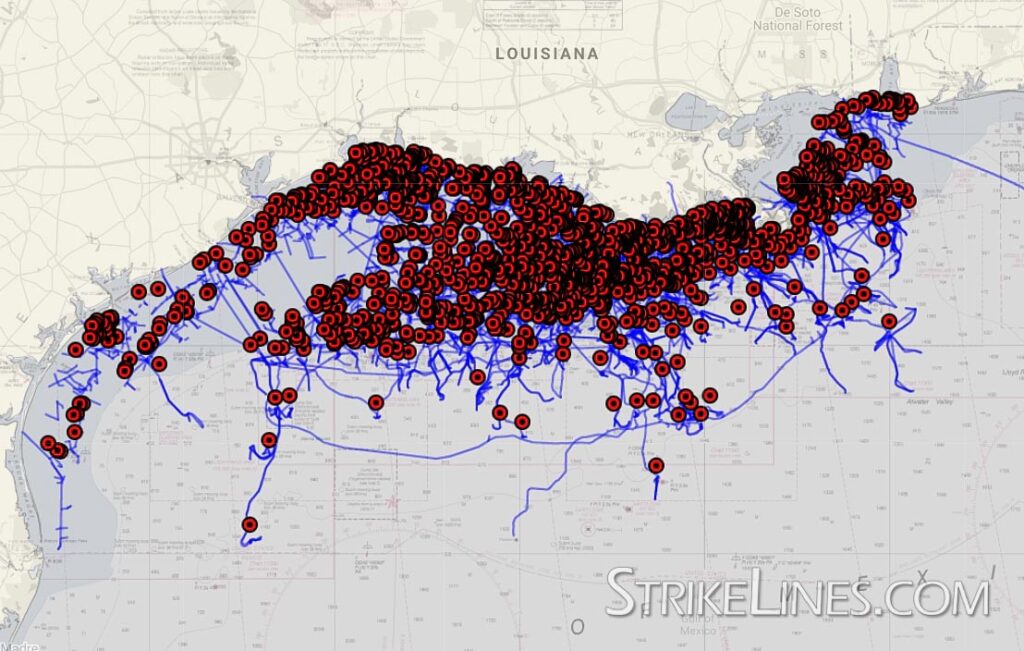
Caption: Platforms and lines already stitch the Louisiana shelf. Delfin’s deepwater port is a new node on an old map.
What to watch between now and first LNG
- PHMSA close-out on the Johnson Bayou / UTOS system and a clean return to service.
- Steel cutting and module milestones at Samsung, and whether the $2.9 billion yard package stays on the 2030 path.
- Any binding offtake or equity news on hulls two and three.
- How Station 44 and the Transco interconnect are rated once 0.6 Bcf/d becomes a firm daily pull.
- Whether a 700-foot bypass at WC-167 is built, or whether the existing platform piping is reused.
- First-gas procedures: who owns the ESD between the pipeline and the hull.
None of those items are glamorous. All of them are why a floating plant still belongs in a pipeline journal.
Bottom line
Delfin FLNG 1 is the first time U.S. regulators, U.S. pipeline gas and a Korean shipyard have been asked to make LNG in the same sentence. The $5 billion FID is real. The 4.4 mtpa number is real. The 2030 date is a construction date, not a press date.
For this audience the project is not “America goes floating.” It is a test of whether brownfield Gulf pipe can feed a world-scale cold box without another explosion, another order and another year on the calendar. If the line holds, floating liquefaction becomes a serious Gulf export class. If it does not, the hull will wait on a weld in Cameron Parish — which is how energy projects have always worked.