Oko Immanuel
Petroleum / Subsea Engineer
Founder, Offshore Pipeline Insight
March 06, 2026
Carbon capture and storage (CCS), often expanded to CCUS (with utilization), is accelerating in 2026 as a key pillar of industrial decarbonization and net-zero goals. Pipelines play a central role in the value chain: transporting captured CO₂ from industrial sources (e.g., power plants, refineries, hydrogen/ammonia production) to permanent storage sites—often depleted reservoirs or saline aquifers onshore or offshore.With over 5,000 miles of CO₂ pipelines already operating safely in the US (transporting millions of tons annually) and global project pipelines exceeding 400–430 MtCO₂/year capacity by 2030, 2026 marks a transition from pilots to large-scale infrastructure. Events like the CO₂ Pipelines Summit 2026 in Houston and DECARBON 2026 highlight the focus on transport networks, repurposing, and safety.
This post explores CO₂ pipeline transport in CCS, current 2026 trends (including offshore/subsea developments), key integrity challenges, and synergies with existing pipeline expertise.
The Role of Pipelines in CCS/CCUSCaptured CO₂ is typically compressed to supercritical state (dense phase, >1,070 psig, ~31°C critical point) for efficient, high-volume transport—similar to natural gas but with unique properties (non-flammable, odorless, but corrosive in wet conditions).
- Onshore dominance: Pipelines remain the primary method for large-volume transport, especially in regions with legacy oil/gas infrastructure (e.g., US Gulf Coast, Midwest ethanol plants).
- Offshore/subsea growth: Europe leads with projects like Northern Lights (Norway, world’s first third-party open-access CO₂ transport/storage, operational since 2025–2026 phase-ups), Porthos (Netherlands, operational 2026, ~2.5 MtCO₂/year to North Sea depleted fields), and Humber CCS (UK, onshore pipeline to offshore storage).
- Shipping alternatives: Gaining traction in Europe for cross-border (e.g., to shared North Sea hubs), but pipelines preferred for high-throughput, point-to-point routes.
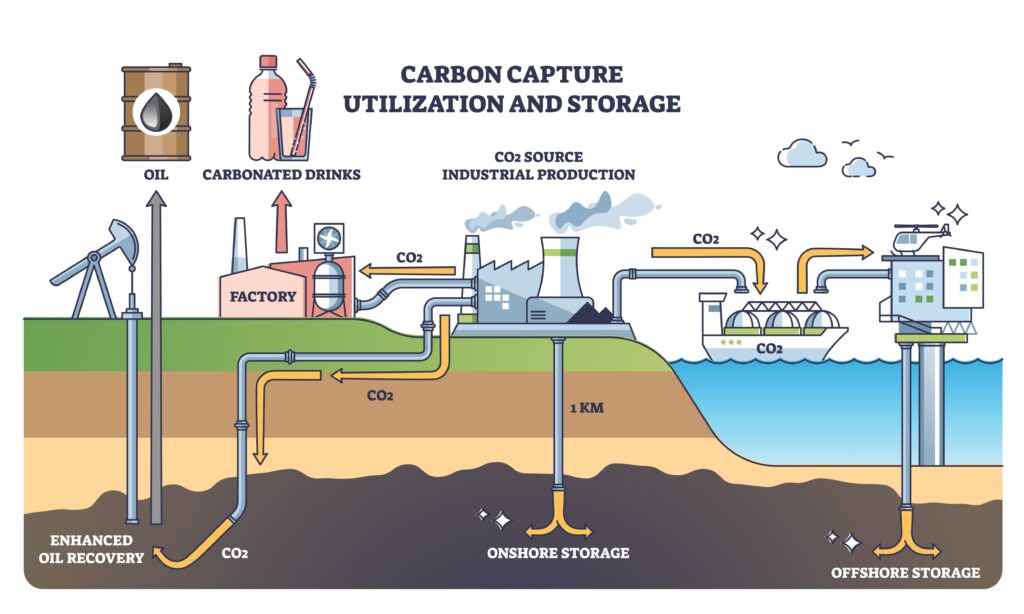
This diagram illustrates the full CCS value chain, including CO₂ capture, pipeline transport (onshore/offshore), and storage:
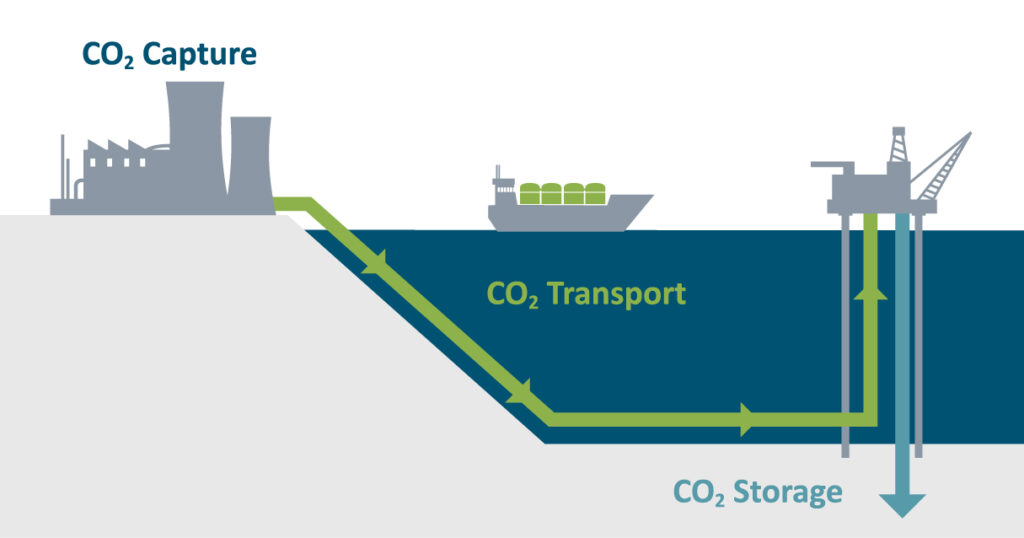
Another schematic shows offshore transport options, from subsea pipelines to ship-based delivery to platforms:
2026 Trends and Key Developments
- US focus: >5,000 miles existing; PHMSA updates sought for modernized safety regs (e.g., February 2026 letter from Carbon Capture Coalition). Major hubs in Gulf Coast (ExxonMobil’s network potential >100 Mt/year reduction), Texas (34+ proposed projects, including sequestration hubs like Bayou Bend, Lone Star).
- Europe momentum: Infrastructure expansion (e.g., Denmark’s first offshore storage approval, UK’s £21.7B CCUS funding, Germany’s revised CO₂ Storage/Transport Act). Northern Lights Phase 2 scaling to 5+ Mt/year; Porthos/Aramis in Rotterdam.
- Global pipeline: ~600+ CCUS projects in development (15% YoY growth); onshore pipelines dominant, but offshore storage hubs (e.g., North Sea) drive subsea lines.
- Policy/regulatory: Midwest US legislation addresses eminent domain, risk assessments; Louisiana debates sharing pipelines between facilities.
Integrity Challenges for CO₂ Pipelines
Transporting supercritical CO₂ introduces unique risks compared to hydrocarbons:
- Corrosion: Wet CO₂ causes severe internal corrosion (carbonic acid formation); dehydration critical to <50 ppm water. External threats similar to oil/gas lines.
- Phase behavior & pressure: Must maintain >1,070 psig to avoid phase change (liquid to gas → pressure spikes, running ductile fractures). Existing natural gas lines often lack sufficient pressure rating/steel toughness.
- Repurposing existing pipelines: Cost-effective (1–10% of new build), but challenges include:
- Material compatibility (e.g., elastomers/seals dissolved by CO₂).
- Insufficient toughness for running fractures in dense phase.
- Re-qualification needed (integrity assessment, hydrostatic testing, finite element modeling for defects).
- Offshore: Complex phase changes, fatigue from platform motions.
- Safety & leakage: CO₂ denser than air (asphyxiation risk in low areas); rapid depressurization can cause explosive failures.
Ongoing JIPs (e.g., DNV’s Skylark, CO2SafePipe) address these via advanced modeling, material upgrades, and monitoring (fiber-optic for leak/strain detection).
Opportunities for Pipeline ProfessionalsAs a subsea/pipeline engineer, 2026 offers direct crossovers: integrity tools (ILI, digital twins), material selection (CRA for sour CO₂), and offshore expertise (dynamic lines, mooring parallels) transfer seamlessly to CO₂ systems. Repurposing avoids stranded assets while enabling CCS scale-up.
With events like CO₂ Pipelines Summit and regulatory pushes, pipelines are the backbone of CCS deployment. What challenges or projects in CO₂ transport intrigue you most?
Drop thoughts in the comments!
Oko Immanuel
Petroleum / Subsea Engineer
Founder, Offshore Pipeline Insight
March 06, 2026