
By Oko
Founder, Offshore Pipeline Insight
June 16, 2026
Flaring of associated gas remains a major challenge in the oil and gas industry. It wastes valuable resources and contributes significantly to greenhouse gas emissions. One of the most effective and relatively low-cost solutions for reducing flaring is Ejector Flare Gas Recovery.
This article explains how ejector-based flare gas recovery systems work, their advantages, and why they are increasingly used in both onshore and offshore facilities.
What is Flare Gas Recovery?
Flare gas recovery involves capturing gas that would otherwise be burned in a flare stack and redirecting it for useful purposes — such as fuel gas, re-injection, or sales.Traditional flare gas recovery systems often use compressors. However, ejector (or eductor) systems offer a simpler, more reliable, and lower-maintenance alternative in many applications.
How Does an Ejector Work in Flare Gas Recovery?
An ejector is a static device with no moving parts. It uses a high-pressure motive fluid (usually gas or steam) to create a vacuum that draws in low-pressure flare gas and compresses it to a higher pressure.The basic principle is based on the Venturi effect:
- High-pressure motive gas enters the ejector at high velocity.
- This creates a low-pressure zone that sucks in the flare gas.
- The mixed gases are then discharged at an intermediate pressure suitable for the fuel gas system or other uses.
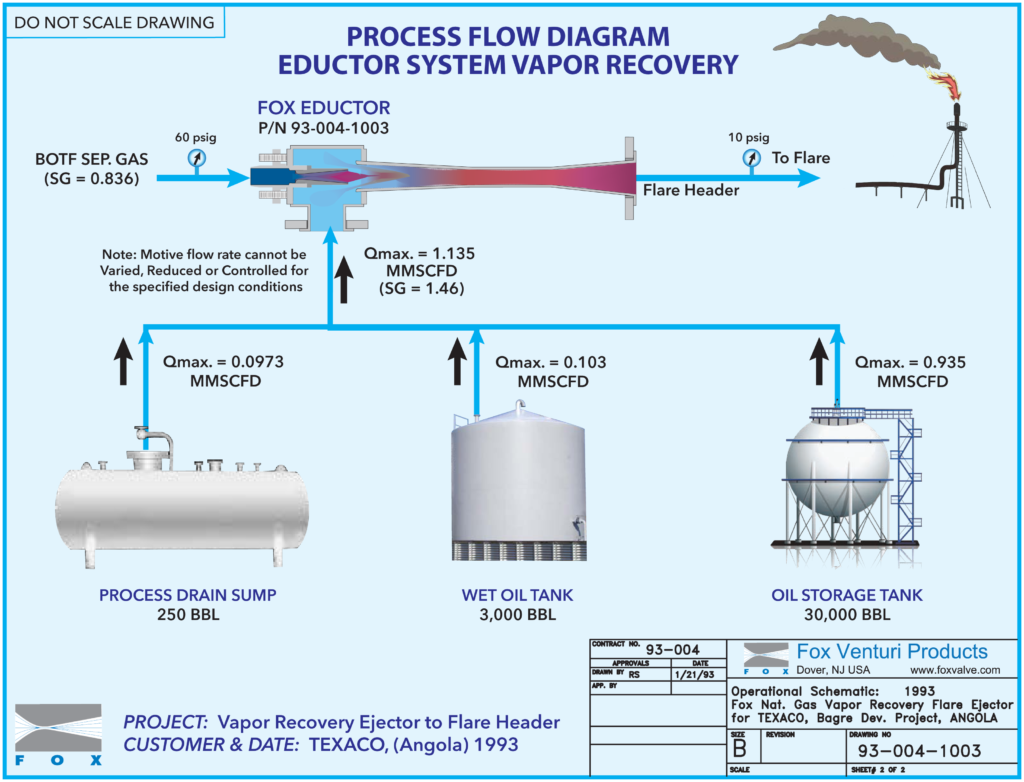
Process Flow Diagram of an Eductor (Ejector) Flare Gas Recovery SystemSystem Components
A typical ejector flare gas recovery system includes:
- Ejector / Eductor: The core device that recovers and compresses the gas.
- Motive Gas Source: Usually high-pressure gas from the facility (e.g., from compressors or export gas).
- Knockout Drum: Removes liquids from the recovered gas.
- Control Valves and Instrumentation: For stable operation.
- Flare Header Connection: Where low-pressure gas is captured before reaching the flare.
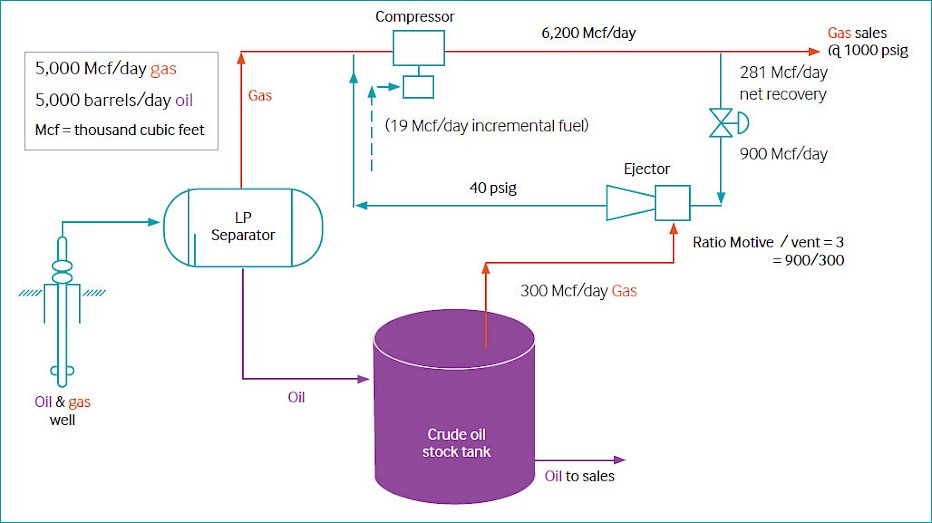
Schematic showing an ejector integrated into a gas recovery system
Advantages of Ejector Flare Gas Recovery Systems
| Advantage | Description | Benefit |
|---|---|---|
| No Moving Parts | Simple design with no compressor or rotating equipment | Lower maintenance and higher reliability |
| Low Capital Cost | Significantly cheaper than compressor-based systems | Faster payback period |
| Easy Installation | Compact and can be installed with minimal modifications | Suitable for both new and existing facilities |
| Handles Variable Flow | Can operate effectively across a wide range of gas flow rates | Good for facilities with fluctuating production |
| Low Operating Cost | Uses existing high-pressure gas as motive fluid | Reduces energy consumption |
| Quick Deployment | Shorter installation time compared to compressor systems | Faster implementation |
Applications in Oil & Gas
Ejector flare gas recovery systems are widely used in:
- Offshore Platforms — Where space and weight are limited
- Onshore Production Facilities — Especially in remote locations
- Refineries and Gas Plants — For recovering low-pressure vent gases
- Early Production Facilities (EPFs) — Where quick deployment is needed
They are particularly effective in facilities that already have a source of high-pressure gas available as motive fluid.
Environmental and Economic Benefits
Recovering flare gas using ejectors helps operators:
- Reduce methane emissions and meet environmental regulations
- Comply with World Bank Zero Routine Flaring initiatives
- Generate additional revenue by using recovered gas as fuel or for sales
- Improve overall facility energy efficiency
In many cases, ejector systems can recover 70–90% of low-pressure flare gas, depending on system design and available motive pressure.
Challenges and Considerations
While ejector systems offer many benefits, they also have some limitations:
- Performance depends on the availability of sufficient motive gas pressure
- Not suitable for very high recovery volumes (compressors may be better)
- Requires proper design and sizing for optimal efficiency
- May need a backup system during maintenance or low motive gas availability
Conclusion
Ejector flare gas recovery systems provide a practical, cost-effective, and reliable solution for reducing gas flaring in oil and gas operations. Their simplicity, low maintenance requirements, and ability to use existing high-pressure gas make them an attractive option — especially for offshore platforms and facilities looking for quick wins in emissions reduction.
As environmental regulations tighten and the industry focuses on reducing its carbon footprint, ejector-based recovery systems are expected to play an increasingly important role in flare gas management strategies.
If you are interested in this product or any other products you can check it out here https://amzn.to/4eybHJM