Tags: LNG, pipelines, Qatar, Hormuz, technical, sendout
By Oko Immanuel, Founder, Offshore Pipeline Insight
Crude can change ports. Pipeline gas can change countries. LNG cannot change state without a factory. That is the engineering under Al-Kaabi’s “no.”This is the deeper cut of the Qatar / Hormuz news piece. Same story. More pipe, more cold boxes, less speech.
Two products that share a name People say “gas.” They mean two different fluids.
Pipeline gas is methane (plus ethane, some inerts) at roughly ambient temperature, pushed at 50–100 bar through steel. Compressor stations every 100–200 km make up the friction. You can bury it, bury it offshore, or hang it on a rack. The molecule never changes phase.LNG is that gas cooled to about −162 °C until it becomes a liquid about 1/600th the volume. It lives in a vacuum-insulated tank, not in a normal transmission line. To use it in a kitchen or a power plant you must warm it back into gas — sendout / regas — then hand it to a normal pipeline. Al-Kaabi’s point was not “pipes are impossible.
” It was: you cannot put the product Qatar already made (LNG) into a land line and call Hormuz solved. You would have to send gas, then build new liquefaction on the far side. That is a second factory next to the one Qatar is already expanding at Ras Laffan.
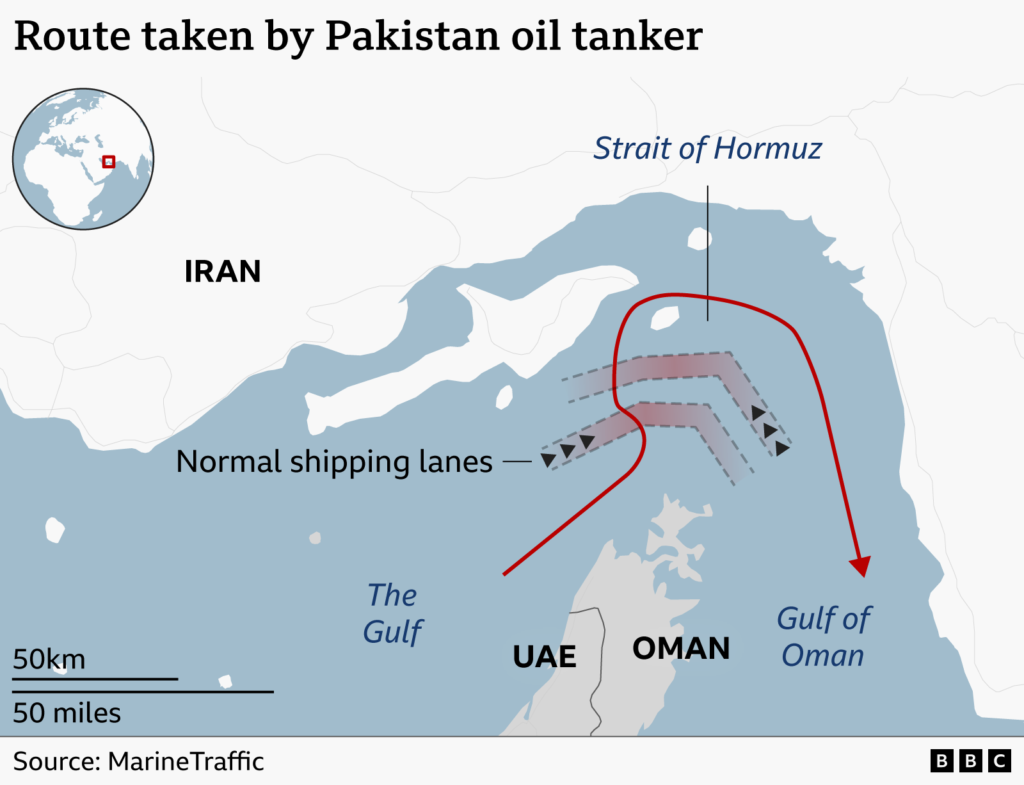
Caption: Hormuz is a ship problem. A land line can move gas. It cannot move a cargo that has already been chilled to −162 °C.
Why you do not “pipe LNG” for 400 km
Cryogenic LNG lines exist. They are in-plant: tank to jetty, tank to vaporizer, a few kilometres of vacuum-jacketed or heavily insulated stainless. Brunei once ran a surface LNG line on the order of miles, not hundreds of kilometres. A 9 km underwater LNG test line has been tried. That is still a plant header, not a trunkline.
A long LNG pipeline would have to:
- stay near −160 °C for the whole route
- fight heat leak (boil-off gas every hour)
- use special alloys and vacuum or foam jackets
- handle cooldown, warm-up, and a leak that is both a fire risk and a brittle-fracture risk
- cost like a linear cold box, not like X65 line pipe
That is why nobody builds a Ras Laffan–Fujairah LNG line. The industry already solved long distance with ships, which are floating tanks.
Kitchen version: you can pipe cold beer across a room in an insulated tap line. You do not pipe it from Doha to Oman in that tap line. You send kegs. Or you send warm wort and brew again — which is the “pipe gas, then liquefy” option.
What “sendout” actually is
At an import terminal or an FSRU, sendout is the last factory step:
- LNG sits in a tank. Heat leak makes boil-off gas (BOG). Compress it or reliquefy it.
- In-tank / sendout pumps lift the liquid to pipeline pressure.
- Vaporizers add heat:
- ORV — seawater down an aluminium rack (cheap, needs clean seawater)
- SCV — burn a slip of gas under a water bath (works in any climate)
- IFV — intermediate fluid (glycol / propane loop)
- Adjust Wobbe Index and calorific value if the grid is fussy.
- Odorize, meter, enter the pipeline.
Only after step 5 do you have “pipeline gas.” Until then you have a cryogenic liquid and a heater.
Qatar’s export plant is the mirror image: treat gas, liquefy, store, load a ship. The expensive soul of that chain is the liquefaction train, not the jetty.
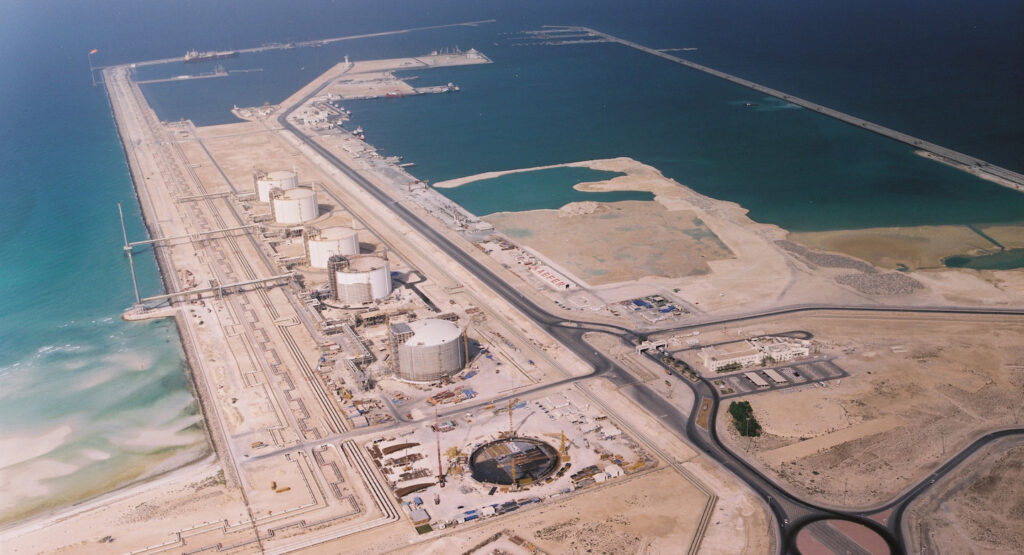
Caption: Ras Laffan is tanks plus trains plus a jetty. A Hormuz bypass that arrives as LNG would have to rebuild those trains somewhere else.
The three bypasses people confuse
A. Pipe crude around Hormuz
Saudi East–West to Yanbu, then a tanker. Crude is still crude. No phase change. This works.
B. Pipe sales gas to a neighbour and burn it there
Technically normal transmission: treat, compress, 56-inch class line, stations. The customer must want gas, not LNG cargoes for Japan and Korea. Qatar’s book is LNG.
C. Pipe sales gas to a neighbour and liquefy it there
This is the only way to “keep LNG customers” without ships through Hormuz. It means:
- a cross-border gas line (treat + compress + right-of-way through a war)
- a new liquefaction plant on the Gulf of Oman or in the UAE
- new tanks and a new jetty
- stranded utilisation at Ras Laffan, where Qatar is already spending on North Field expansion
Al-Kaabi called that redundant facilities. In project language: you double the cold-box capex to save a two-day sea passage that is currently dangerous.
That is a commercial “no.” It is also a schedule “no.” A new train is years. Two damaged Ras Laffan trains are already a three-year repair speech.
Distance maths (why ships exist)
Rule of thumb, not a law:
- Onshore gas pipeline often beats LNG out to about 3,000–4,000 km.
- Offshore pipe is dearer; LNG can win beyond about 1,500–2,000 km.
- An ocean, or a strait you cannot politically trench, is an LNG job.
Qatar to Japan is an ocean. Qatar to Fujairah is a short land hop — if the product is gas. Qatar to Fujairah as LNG is a cryogenic fantasy. Qatar to Fujairah as gas then new trains is a second Ras Laffan.
Pipeline tariffs rise with kilometres (steel + compression). LNG cost is front-loaded in the plant; the ship adds relatively little per 1,000 km. That is why a cargo to Korea and a cargo to India can share one train. A land line cannot.
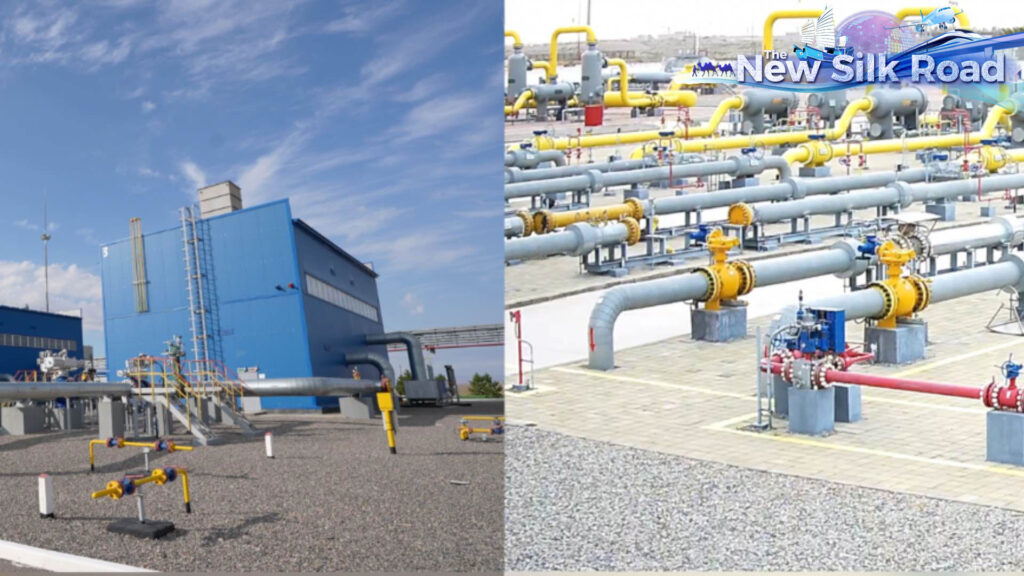
Caption: This is pipeline gas: yellow valves, compressors, ambient steel. No −162 °C. No ship. Also no substitute for a Ras Laffan cargo bound for Asia.
What would a “gas bypass” still have to solve
If someone ignored Al-Kaabi and built option C anyway:
- Inlet spec: North Field gas is not pipeline-ready. Acid gas, water, C5+, mercury — treating stays on the Qatari side or moves with the line.
- Capacity: one large LNG train is several million tonnes per year. That is a big gas pipeline, not a utility lateral.
- Compression in desert heat. Stations, fuel gas, reliability.
- Cross-border leak and ESD philosophy. Two regulators.
- War risk on the ditch you just dug to avoid war risk on the ship.
- BOG and cooldown if anyone is still pretending the line carries LNG.
Option B (gas to a local burner) is easier engineering and the wrong product for Qatar’s contracts.
Why this sits with Delfin and Commonwealth
A U.S. Gulf train or a Pacific train never enters Hormuz. Sendout at Dahej or Incheon does not care whether the molecule was chilled in Qatar, Louisiana or Kitimat.That is the spare factory. Not a ditch to Fujairah.
Bottom line
Pipeline gas is compressed methane in warm steel.
LNG sendout is a pump, a heater and then pipeline gas.
Qatar’s export is the chilled liquid in the middle.You can pipe gas around Hormuz. You cannot pipe LNG around Hormuz without building a second liquefaction plant — which is the part that already costs the billions. That is the engineering under the minister’s sentence.
Read with: Hydrates · SURF · Walking and burial. News sister: Qatar LNG cannot go by pipeline.