Written by Oko
Founder, Offshore Pipeline Insight
June 16, 2026.
On January 21, 2026, the National Oceanic and Atmospheric Administration (NOAA) finalized a major new rule to accelerate permitting for deep seabed mining in international waters. This development is part of the U.S. strategy to secure critical minerals needed for the energy transition.
What is the New NOAA Rule?
NOAA issued the final rule titled “Deep Seabed Mining: Revisions to Regulations for Exploration License and Commercial Recovery Permit Applications.”
The most significant change is the creation of a consolidated application process, allowing companies to apply for both an exploration license and a commercial recovery permit at the same time — something that was previously done in two separate stages.
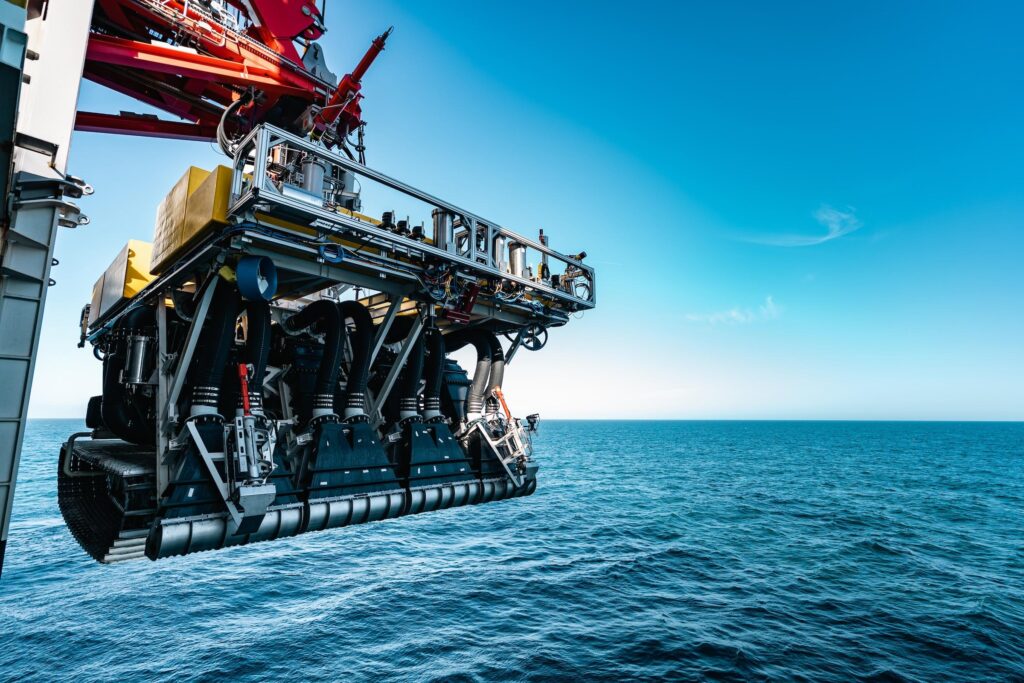
Nodule collection system being deployed from a support vessel — one of the key pieces of equipment used in deep-sea mining.
Key Equipment Used in Deep-Sea Mining
Modern deep-sea mining operations rely on advanced, remotely operated equipment designed to work at extreme depths.

Deep-sea nodule collector vehicle operating on the ocean floor.
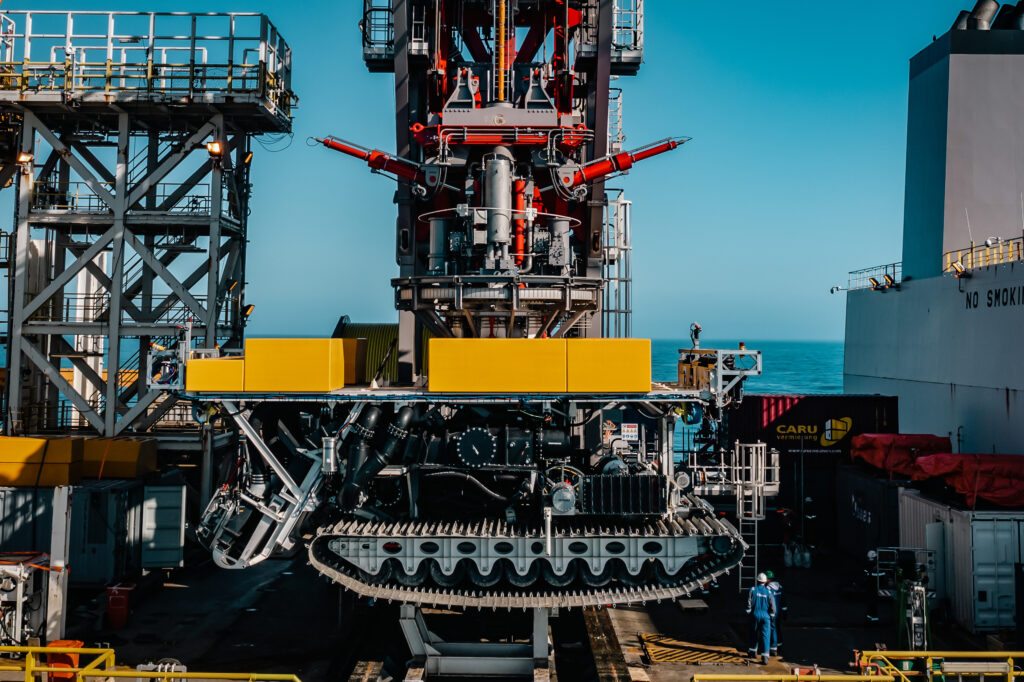
Large-scale nodule mining equipment on the deck of a support vessel.
These machines are built to collect poly-metallic nodules while minimizing (as much as possible) disturbance to the seabed.
Why Was This Rule Introduced?
The rule supports Executive Order 14285 (April 2025), which directed federal agencies to speed up the development of U.S. offshore critical mineral resources. The goal is to reduce dependence on foreign mineral supplies and support domestic battery and clean energy manufacturing.
NOAA vs ISA:
Key Regulatory Comparison
One of the most important aspects of this new U.S. rule is how it differs from the international framework managed by the International Seabed Authority (ISA).
| Aspect | NOAA (U.S. Rule – 2026) | International Seabed Authority (ISA) | Key Difference |
|---|---|---|---|
| Jurisdiction | International waters (for U.S. companies) | The “Area” (international seabed beyond national jurisdiction) | U.S. operates outside ISA framework |
| Application Process | Consolidated (Exploration + Commercial in one step) | Two-stage process (Exploration contract first, then Exploitation) | U.S. process is faster |
| Goal | Speed up permitting and attract investment | Ensure environmental protection + equitable benefit sharing | Different priorities |
| Environmental Standards | Requires environmental review | Strong emphasis on precautionary approach | ISA generally stricter |
| Status of Exploitation Rules | Already allows commercial permit applications | Exploitation regulations still under development | U.S. is ahead in permitting |
| International Legitimacy | Based on U.S. domestic law (DSHMRA) | Based on UNCLOS (U.S. is not a party) | Major point of global debate |
The U.S. has never ratified the UN Convention on the Law of the Sea (UNCLOS), which is why it operates its own system through NOAA rather than joining the ISA framework.
Potential Impact of the New NOAA RuleAdvantages:
- Significantly reduces permitting time (estimated reduction of ~100 days).
- Provides clearer and faster pathway for U.S. companies.
- Strengthens U.S. position in the global critical minerals race.
Concerns:
- Environmental groups worry that faster permitting may reduce the depth of environmental reviews.
- Some countries and organizations argue that unilateral U.S. action undermines international ocean governance.
- Questions remain about long-term environmental protection standards.
Conclusion
NOAA’s January 2026 rule marks a clear policy shift by the United States to move faster on deep seabed mining. By streamlining the permitting process, the U.S. is positioning itself to compete more aggressively in the race for critical minerals.
However, this approach also highlights the growing divide between the U.S. regulatory path and the international framework led by the International Seabed Authority. As more applications are submitted under the new rules, the coming years will show how this accelerated approach balances economic goals with environmental protection in the deep ocean.
If you are interested in any of this product, you can check it out here https://amzn.to/4eybHJM