By Oko Immanuel, M.Eng – Founder, Offshore Pipeline Insight
March 20, 2026
Offshore pipelines are the unseen backbone of global energy supply. They transport crude oil, natural gas, condensate, and other hydrocarbons across hundreds or thousands of kilometers beneath the ocean, linking subsea wells to platforms, platforms to onshore terminals, or entire fields to markets.
What are offshore pipelines?
In simple terms, an offshore pipeline is a high-strength pipe system laid on or buried under the seabed to move fluids safely and efficiently from offshore production sites to processing facilities or shore. They operate in extreme conditions: water depths up to 3,000+ meters, pressures exceeding 15,000–20,000 psi in HPHT fields, temperatures from near-freezing at the seabed to over 350°F inside the pipe, corrosive fluids, strong currents, and seismic/Geo -hazard risks.
Are there oil pipelines under the ocean?
Yes — absolutely. There are tens of thousands of kilometers of oil pipelines on the seabed worldwide. Major examples include:
- The ~500 km trunk lines in Qatar’s North Field East (NFE) expansion.
- Extensive export networks in the U.S. Gulf of Mexico (GoM) carrying millions of barrels daily.
- Brazil’s pre-salt basin tiebacks (Santos and Campos basins).
- Guyana’s Stabroek Block export lines.
- North Sea intra-field and export pipelines.
These lines routinely carry crude oil, condensate, and multiphase fluids under high pressure and temperature for decades.
Classification of Offshore Pipelines
Offshore pipelines are classified in several practical ways:
- By Function / Purpose
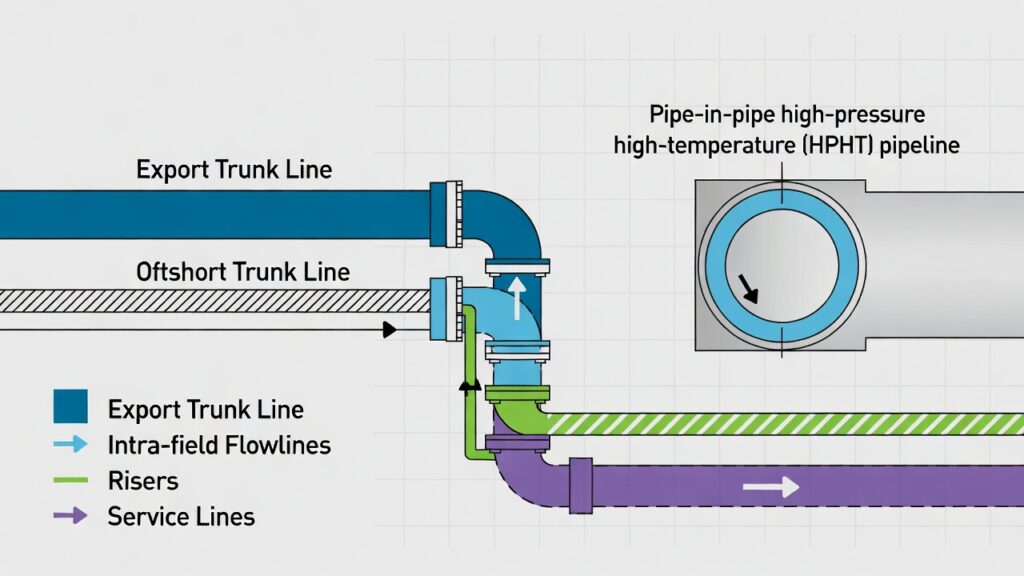
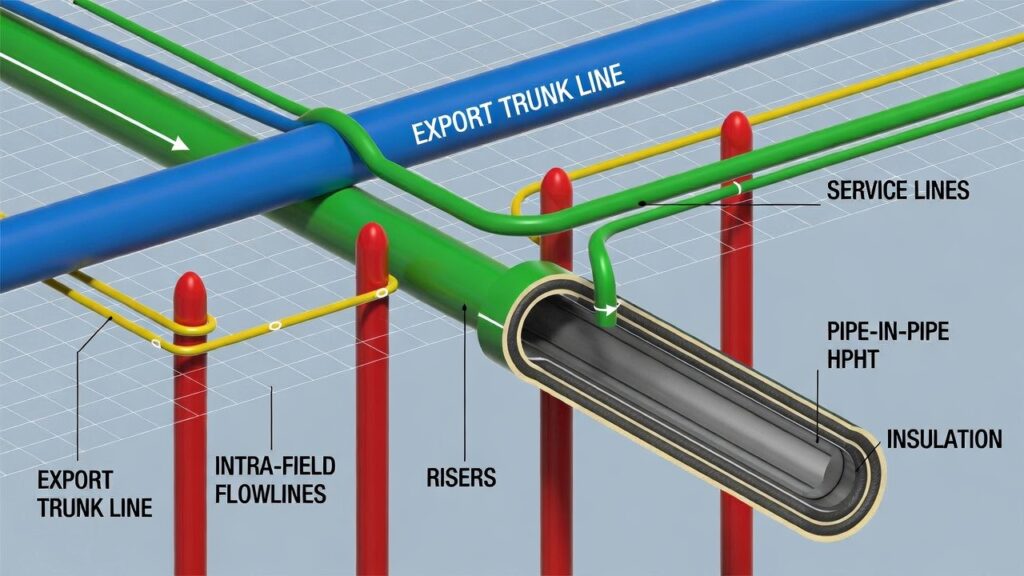
- Export / Trunk Pipelines: Large-diameter lines that carry processed oil or gas from platforms to shore terminals or to another offshore hub (e.g., 24–48 inch diameter).
- Flowlines / Intra-field Pipelines: Smaller-diameter lines connecting individual wells to manifolds, risers, or processing platforms within a field.
- Riser Pipelines: Vertical or catenary sections that connect subsea flowlines to surface facilities (fixed platforms, FPSOs, or spars).
- Service / Injection Lines: Carry water, gas lift, chemicals, or CO₂ for injection, maintenance, or enhanced recovery.
- By Installation Type
- Surface-laid (unburied, resting on seabed).
- Trench & buried (protected from fishing gear, anchors, currents).
- Bundled (multiple lines in one carrier pipe).
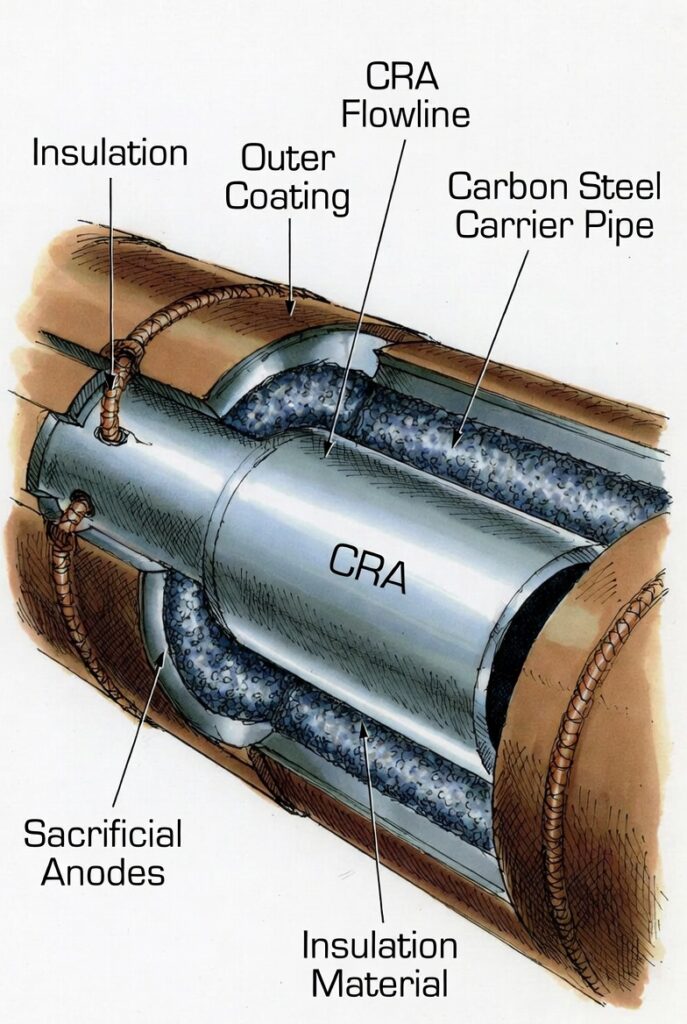
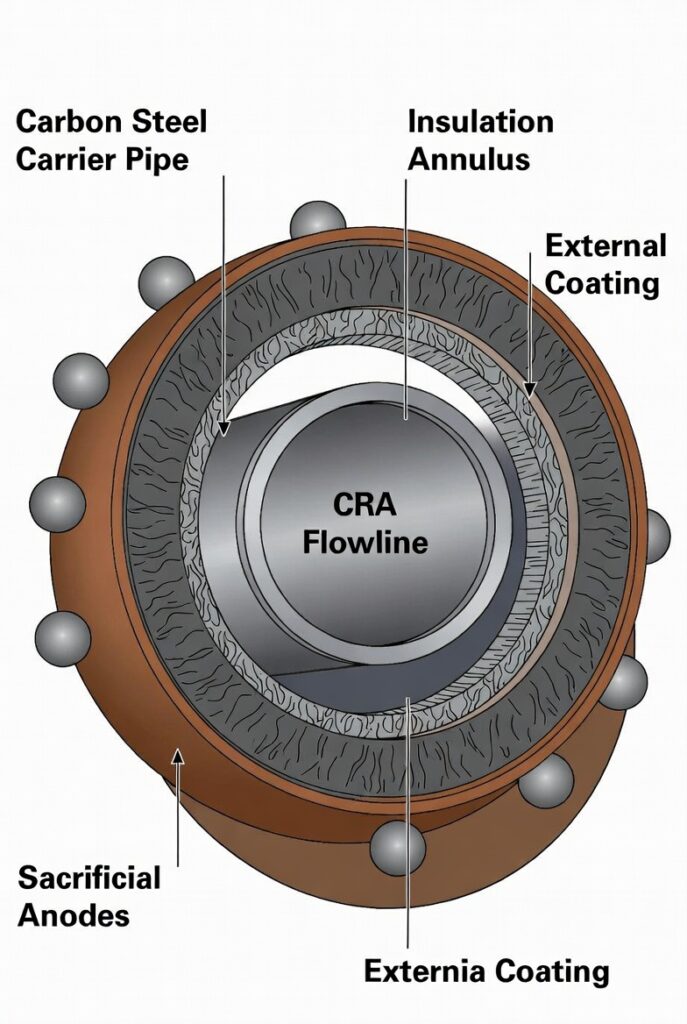
- Pipe-in-Pipe (PIP) (inner flowline + outer carrier with insulation annulus for HPHT thermal management).
- By Pressure & Temperature Rating
- Conventional (≤10,000 psi, <250°F).
- High-Pressure High-Temperature (HPHT) (15,000–20,000+ psi, >300°F) — the fastest-growing and most technically demanding segment in 2026.
Figure 1: Offshore Pipeline Classification Overview
(image: Color-coded schematic showing export trunk line, intra-field flow lines, risers, service lines, and pipe-in-pipe HPHT cross-section with labels for each type.)
Materials Used in Offshore PipelinesOffshore pipelines must resist corrosion, pressure collapse, buckling, fatigue, and thermal expansion for 30–50 years.
- Carbon Steel (API 5L Grades X60–X80): The most common material for conventional lines. High strength-to-cost ratio but requires corrosion protection.
- Coatings: 3-layer polyethylene (3LPE), fusion-bonded epoxy (FBE), or concrete weight coating for negative buoyancy.
- Cathodic protection (sacrificial anodes or impressed current) to prevent external corrosion.
- Corrosion-Resistant Alloys (CRA): Used in HPHT, sour (H₂S), or CO₂-rich service.
- Duplex / Super Duplex stainless steel (22Cr, 25Cr).
- 13Cr martensitic stainless steel.
- Inconel 625, Alloy 825 for inner liners in pipe-in-pipe systems.
- Pipe-in-Pipe (PIP) Systems: Inner CRA or high-alloy pipe for corrosion resistance + outer carbon steel carrier for structural strength, with insulation material (foam, aerogel) in the annulus for thermal management.
- Flexible & Composite Pipes: Growing use for shorter dynamic risers and tiebacks. Lighter, better fatigue resistance, easier installation.
Figure 2: Typical HPHT Pipe-in-Pipe Cross-Section
( image: Cutaway diagram showing inner CRA flowline, insulation annulus, outer carbon steel carrier pipe, coatings, and anodes.)
How Offshore Pipelines Are Built in the Ocean (Step-by-Step Process)
- Route Survey & Design
- Seabed geophysical/geotechnical surveys (multibeam echo sounder, side-scan sonar, CPT).
- Geohazard assessment (slopes, faults, shallow gas).
- Thermal, pressure, fatigue, and flow assurance modeling.
- Pipe Manufacturing & Preparation
- Double-joint or triple-joint welding onshore.
- External coating (3LPE/FBE) and concrete weight coating (if required).
- Internal lining or CRA clad pipe for corrosive service.
- Transportation
- Pipes loaded onto pipe-lay vessels, barges, or reel ships.
- Pipe-Laying Operations
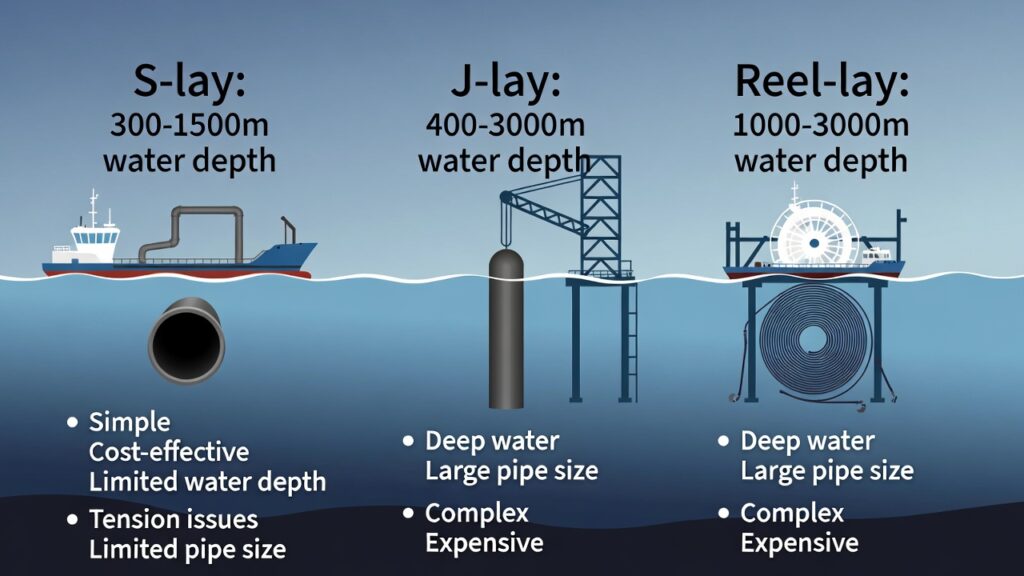
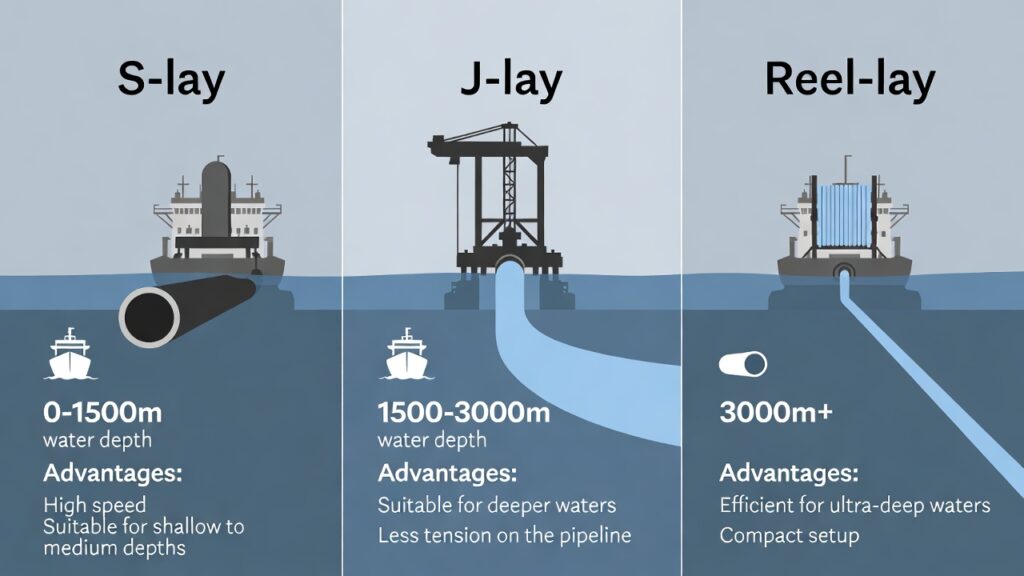
- S-lay: Shallow to mid-depth; pipes welded on deck, lowered in an S-curve using stinger.
- J-lay: Deepwater/ultra-deepwater; near-vertical welding, J-shaped catenary.
- Reel-lay: Pipes pre-welded onshore, spooled onto a reel, unspooled during laying (fast for smaller diameters).
- Trenching & Protection
- Jetting, ploughing, or mechanical trenching to bury the line.
- Rock dumping or concrete mats in high-risk areas (shipping lanes, fishing grounds).
- Subsea Tie-ins & Commissioning
- ROV-guided tie-ins (hot taps, flanges, or mechanical connectors).
- Hydrostatic pressure testing (1.25–1.5× design pressure).
- Pigging for cleaning, gauging, and dewatering.
Figure 3: Offshore Pipeline Installation Methods Comparison
(image: Side-by-side illustrations of S-lay, J-lay, and Reel-lay techniques with vessel types, water depth ranges, and advantages/drawbacks.)
The Bottom Line for 2026
Offshore pipelines are engineering marvels — massive, durable systems that carry energy across the ocean floor for decades. They are classified by function (export, flowline, riser), installation method, and pressure/temperature rating. Materials range from carbon steel with coatings to advanced corrosion-resistant alloys and pipe-in-pipe systems for HPHT service. Construction involves precise surveying, manufacturing, vessel-based laying (S-lay, J-lay, reel-lay), trenching, and rigorous testing.With deepwater and HPHT projects expanding rapidly in 2026 (GoM, Brazil, Guyana, North Sea, Namibia), understanding these pipelines is more important than ever.Engineers and researchers:
What aspect of offshore pipeline design or installation interests you most — HPHT materials, intelligent pigging, or installation challenges?
Drop a comment or connect on LinkedIn.
These lines keep the world moving.
Oko Immanuel
Subsea Engineering Specialist | Offshore Pipeline Insight