By Oko M.Eng
Founder, Offshore Pipeline Insight | Subsea Engineering Specialist
May 13 2026
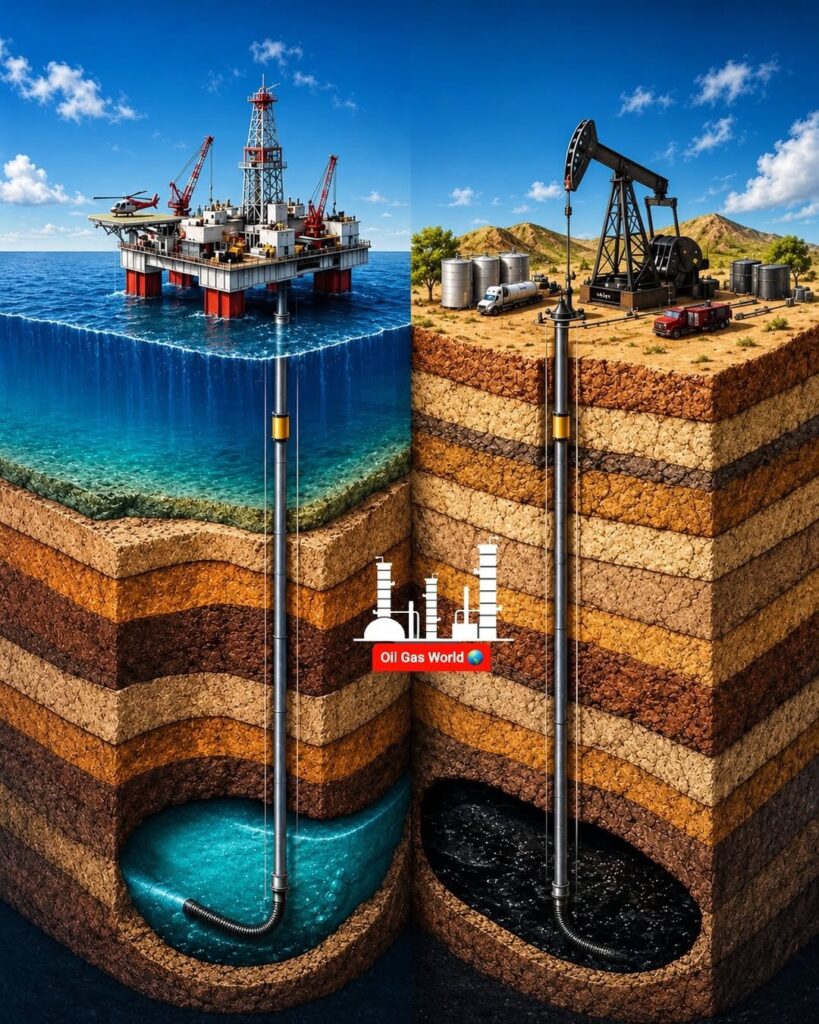
The image below perfectly captures the fundamental contrast between offshore and onshore oil and gas production systems two worlds that look dramatically different on the surface but share the same ultimate goal: safely and efficiently extracting hydrocarbons from deep underground reservoirs.
This powerful cross-section illustrates the complexity of modern offshore developments compared to traditional onshore setups. In 2026, offshore operations dominate high-value production growth, especially in deepwater, HPHT, and long-tieback environments.
1. Offshore vs Onshore: A Side-by-Side Technical Comparison
Offshore and onshore operations differ significantly in engineering demands, costs, safety considerations, and environmental challenges.
| Aspect | Offshore Operations | Onshore Operations | Key Implication for 2026 |
|---|---|---|---|
| Water/Environment | Deepwater (1,000–3,000m+), waves, currents | Land-based, accessible | Higher technical complexity |
| Drilling & Completion Cost | $80–250+ million per well | $5–25 million per well | Capital discipline critical |
| Intervention Access | Limited by marine conditions | Easy rig/equipment access | Remote & digital tools essential |
| Flow Assurance | Long tie-backs, hydrate/wax risks | Shorter pipelines | Advanced insulation & heating |
| Safety & Logistics | Helicopter/ship-dependent, harsh weather | Road access, easier evacuation | Higher OPEX and risk management |
| Environmental Footprint | Smaller surface footprint, higher scrutiny | Larger surface facilities | Stronger ESG focus offshore |
Offshore developments in regions like Guyana, Brazil pre-salt, and Namibia’s Orange Basin are pushing the boundaries of what is technically possible.
2. Well Intervention: Slickline vs Wireline/E-Line – Critical Tools for Offshore Asset Life Extension
Well intervention is one of the most important aspects of maintaining production, especially in mature and HPHT offshore fields. The image below clearly compares the two primary methods used today.
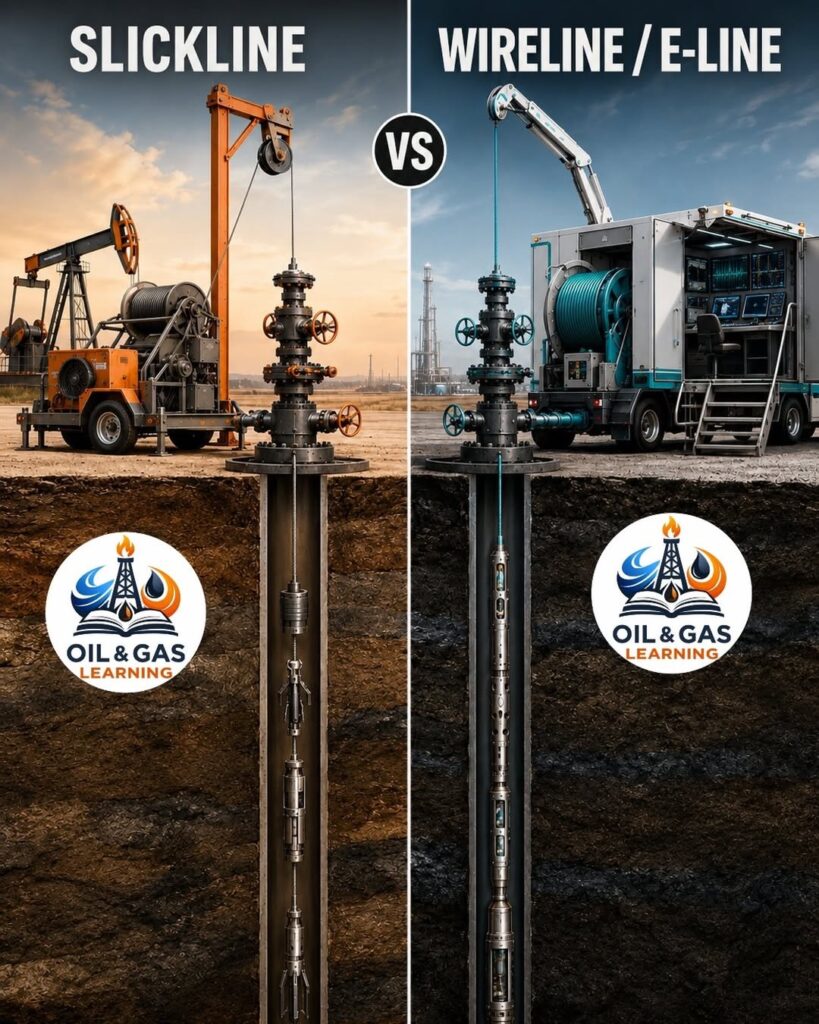
Slick-line and Wireline/E-Line serve different purposes in offshore environments:
Slickline Operations
- Characteristics: Single-strand, non-electric cable (usually 0.092–0.125 inch diameter)
- Applications:
- Running and retrieving downhole tools (plugs, gauges, safety valves)
- Shifting sliding sleeves
- Fishing operations
- Basic memory gauge runs
- Advantages in Offshore: Lightweight, lower deck space requirement, faster mobilization
- Limitations: No real-time data, limited to mechanical operations
Wireline / E-Line Operations
- Characteristics: Multi-conductor electric cable capable of transmitting power and data
- Applications:
- Real-time logging and production profiling
- Perforating guns deployment
- Setting plugs with real-time confirmation
- Fiber-optic distributed sensing (DTS/DAS)
- Reservoir monitoring and sampling
- Advantages: Real-time decision making, complex diagnostics, higher success rate in HPHT wells
- Offshore Challenges: Heavier equipment, higher deck loading, weather sensitivity
In 2026, offshore operators increasingly combine both technologies with digital slick-line and fiber-optic enabled e-line systems to reduce intervention frequency and cost.
3. Why Offshore Intervention is More Challenging in 2026
Offshore environments add layers of complexity:
- Vessel and Rig Dependency: Interventions often require coiled tubing vessels or drilling rigs — very expensive day rates.
- HPHT Conditions: Pressures above 15,000 psi and temperatures over 350°F demand specialized tools and cables.
- Deepwater Reach: Extended-reach wells and long tie-backs make tool deployment more difficult.
- Weather Windows: Operations can be delayed for days or weeks due to storms.
- Regulatory and Safety Standards: Stricter barriers and dual independent verification required.
Modern solutions include:
- Subsea Intervention Systems (e.g., horizontal tree access)
- ROV-deployed tools
- Through-Tubing Technology
- Autonomous Intervention Drones (emerging in 2026 trials)
4. Flow Assurance and Pipeline Integrity – The Hidden Backbone
Whether offshore or onshore, once hydrocarbons reach the wellhead, they must be transported safely. Offshore pipelines face unique challenges:
- Thermal Management: Maintaining temperature over long distances to prevent hydrates and wax.
- Corrosion Management: Use of CRAs, inhibitors, and intelligent pigging.
- Buckling and Fatigue: Especially in HPHT tie-backs with thermal cycling.
- Digital Monitoring: Fiber-optic cables integrated into umbilicals provide real-time strain, temperature, and acoustic data.
5. The 2026 Industry Context
The offshore sector in 2026 is characterized by:
- Selective high-impact exploration (~65 wells globally)
- Rapid production growth in Guyana and Brazil
- Technology acceleration in all-electric subsea and HPHT systems
- Industry consolidation creating stronger contractors
- Heightened focus on energy security and cost efficiency
Operators are extending the life of existing assets through smarter intervention programs while developing new fields with more integrated subsea solutions.
6. Future Outlook: Hybrid Systems and Digital Transformation
By 2028–2030, expect:
- Greater integration of slickline and e-line capabilities in single deployments
- Widespread adoption of all-electric subsea trees
- AI-powered predictive maintenance reducing intervention needs
- Hybrid offshore-onshore developments (e.g., nearshore hubs)
- Increased use of carbon capture readiness in new infrastructure
For subsea pipeline engineers, well intervention specialists, and flow assurance professionals, 2026–2027 offers strong career opportunities. Deep expertise in HPHT materials, long-distance tie-backs, and intervention optimization will be highly valued.
Conclusion
Offshore and onshore operations represent two sides of the same industry — one visible and accessible, the other hidden beneath thousands of meters of water. The technologies that connect reservoir to surface, and the intervention methods that keep wells producing, are what determine project success in 2026 and beyond.
The future belongs to professionals and companies that master both the visible infrastructure and the invisible complexities of the subsurface. Whether designing HPHT pipelines, planning slickline campaigns, or optimizing all-electric subsea systems, excellence in integration will drive the next decade of offshore development.
By Oko Immanuel, M.Eng
Founder, Offshore Pipeline Insight | Subsea Engineering Specialist
May 2026