Written by Oko
Founder, Offshore Pipeline Insight
May 23, 2026
The offshore gas sector is undergoing a technological renaissance. Two key innovations — subsea compression and Floating LNG (FLNG) vessels — are enabling operators to unlock stranded gas reserves, extend field life, and reduce costs while minimizing environmental impact. These technologies work synergistically: subsea compression boosts recovery and delivers gas efficiently to FLNG facilities for liquefaction and export.
This article explores both technologies in depth, with real-world examples and implications for pipeline and integrity management.
Subsea Compression Technologies: Pushing the Boundaries
Subsea compression places gas compression systems directly on the seabed near the wellheads. This reduces backpressure, increases recovery rates, and eliminates or downsizes expensive topside platforms.
Key Advantages
- Higher Recovery Rates: Boosts reservoir pressure, adding 20–50% more recoverable gas.
- Lower OPEX and Emissions: Closer-to-reservoir compression is more energy-efficient (e.g., reducing power needs from ~12 MW to 3.5 MW per unit in some cases).
- Longer Tie-Backs: Enables step-outs of 100+ km.
- Brownfield Revitalization: Ideal for mature fields facing declining pressure.
Major Technologies and Players
- Wet-Gas Compression (multiphase): Handles unprocessed gas with liquids (up to 5%+ Liquid Volume Fraction). Pioneered by SLB OneSubsea (formerly OneSubsea) and Baker Hughes.
- Dry-Gas Compression: Requires separation upstream but offers high efficiency for cleaner streams.
Notable Projects in 2026:
- Ormen Lange (Shell, Norway): Record-breaking deployment at >900 meters water depth — the deepest subsea compression system ever. Two SLB OneSubsea stations came online in 2025, expected to unlock 30–50 billion cubic meters of additional gas.
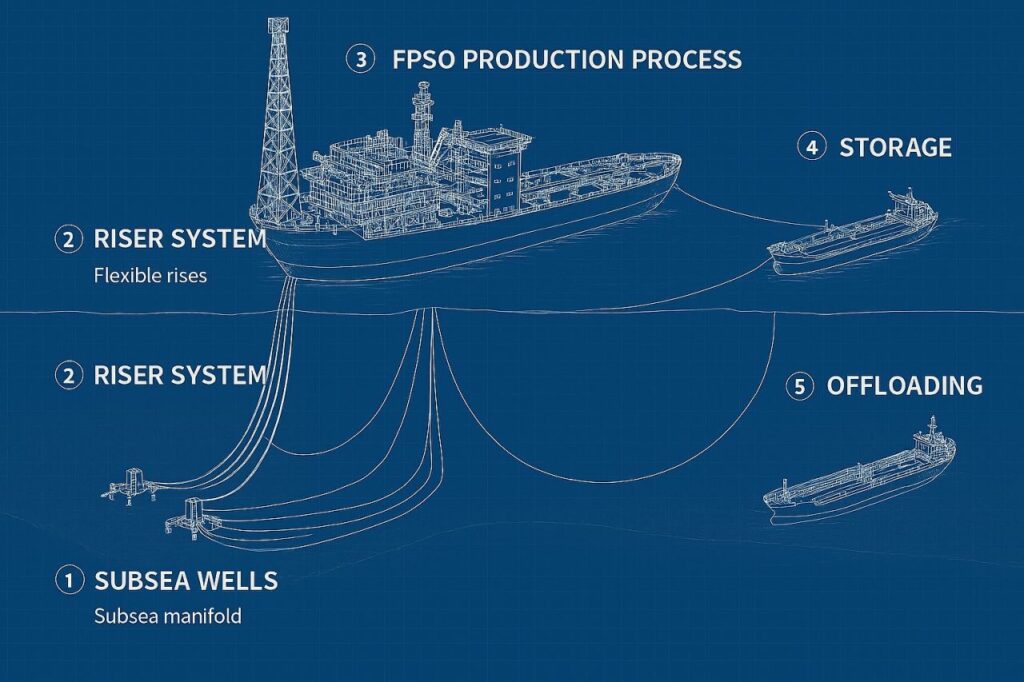
Subsea infrastructure layout showing compression integration with manifolds and flowlines.
- Åsgard (Equinor, Norway): World’s first full-scale subsea gas compression (2015). Phase 2 upgrades in 2025 with next-generation modules continue to deliver strong results, adding hundreds of millions of barrels of oil equivalent.
- Gullfaks (Equinor): SLB OneSubsea awarded contract in early 2026 to upgrade 2015 multiphase compressors with higher capacity modules.
Technical Highlights:
- Blue-C Compressor (Baker Hughes): High-speed centrifugal design tolerant to wet gas.
- Power Systems: Long-distance subsea power distribution with VSDs (Variable Speed Drives), subsea switchgear, and UPS.
- Challenges Addressed: Hydrate management, robust materials for sour service, and advanced condition monitoring via digital twins.
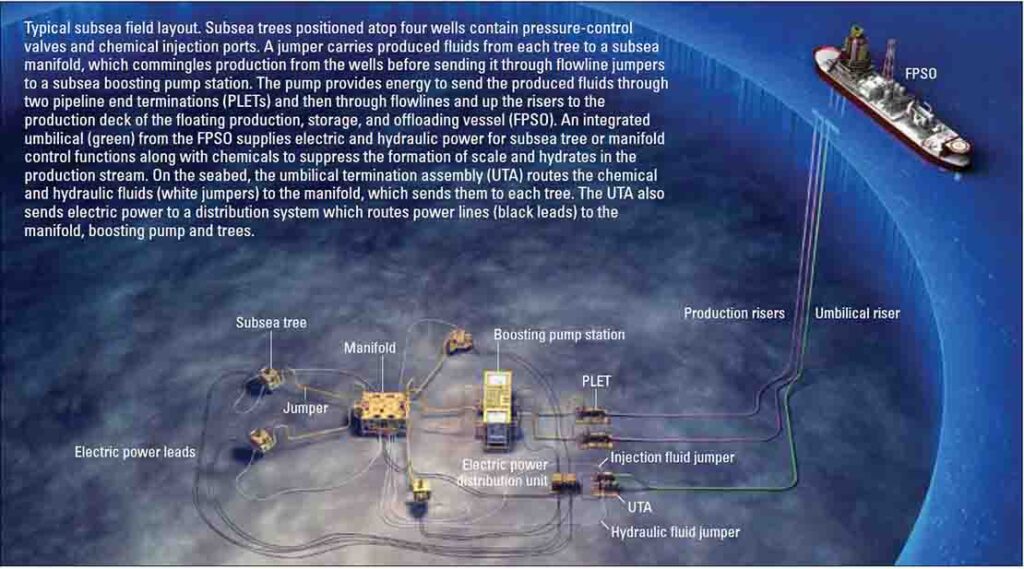
Detailed subsea boosting and compression setup with trees, manifolds, and power umbilicals.FLNG Vessel Designs: Monetizing Gas at SeaFloating Liquefied Natural Gas (FLNG) vessels combine gas processing, liquefaction, storage, and offloading on a single floating facility. This eliminates long export pipelines and onshore plants.Evolution of FLNG Designs
- Early Generation: Conversions of existing LNG carriers (e.g., Golar’s MK II designs) for cost efficiency.
- Newbuilds: Purpose-built hulls like Shell’s Prelude (world’s largest floating facility at ~600,000 tons displacement) or Samsung/Technip projects.
- 2026 Trends:
- Compact modular designs (Megamodule™ concepts).
- Improved motion response hulls (e.g., Cefront axisymmetric or barge-style for stability).
- Higher efficiency liquefaction processes (dual mixed refrigerant, etc.).
- Integration with renewables for lower emissions.
Key Design Features:
- Hull & Containment: Membrane (GTT) or Moss spherical tanks adapted for offshore motions and sloshing.
- Topsides: Compact liquefaction trains, pretreatment (dehydration, acid gas removal), and utilities.
- Mooring & Offloading: Turret or spread mooring with tandem or side-by-side LNG transfer.
- Safety: Enhanced fire/explosion protection, cryogenic spill management, and motion-compensated systems.
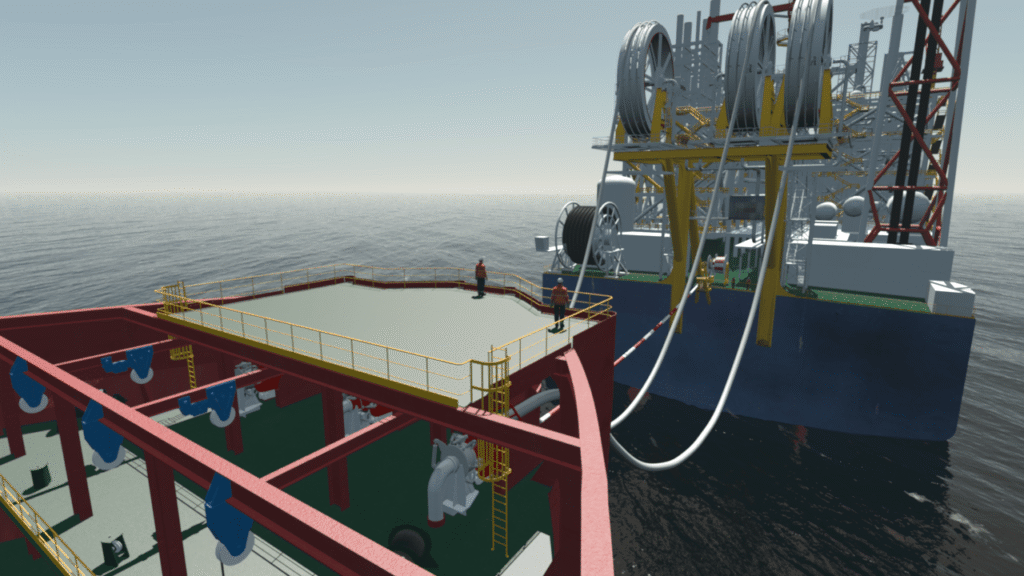
FLNG deck and offloading operations showing complex hose and manifold systems.Recent Projects:
- Coral North (Eni, Mozambique): Hull launched in early 2026.
- Prelude FLNG (Shell, Australia): Operational benchmark for large-scale FLNG.
- Conversions in West Africa and Southeast Asia proving lower CAPEX ($500–640/ton in some cases).
Synergies Between Subsea Compression and FLNGSubsea compression feeds higher-pressure gas to nearby FLNG units or pipelines, improving overall system efficiency. This combination is ideal for deepwater or remote fields where traditional platforms are uneconomical.
Comparison Table: Subsea Compression + FLNG vs Traditional Approaches
| Aspect | Subsea Compression + FLNG | Traditional Onshore + Platforms |
|---|---|---|
| CAPEX | Lower (no long pipelines) | Higher infrastructure costs |
| Development Time | Faster (modular) | Longer permitting & construction |
| Recovery Rate | Significantly higher | Lower due to backpressure |
| Environmental Footprint | Reduced onshore impact | Larger land use & dredging |
| Flexibility | Relocatable | Fixed location |
| Technical Complexity | High (but proven in Norway) | Established but rigid |
Integrity Management & Pipeline Implications
These technologies increase demands on:
- Flow Assurance: Advanced insulation, chemical injection, and hydrate inhibition in longer tie-backs.
- Materials: Sour service resistance and fatigue design for dynamic risers.
- Monitoring: Digital twins and AI for predictive maintenance of compressors and flowlines.
- Inspection: More frequent ROV/AUV surveys and intelligent pigging.
Future Outlook
By 2030, FLNG capacity is projected to triple, while subsea compression becomes standard for deepwater gas. Integration with CCS, hydrogen, and renewables will drive the next wave of innovation.
Recommendations for Operators:
- Conduct early flow assurance and digital twin studies.
- Evaluate hybrid subsea + FLNG concepts for new developments.
- Partner with proven technology providers (SLB OneSubsea, Baker Hughes, Technip, Samsung).
- Prioritize integrity programs tailored to high-pressure, multiphase systems.
These advancements are redefining what’s possible in offshore gas — turning stranded resources into reliable, lower-carbon energy supplies.