Founder & Owner, Offshore Pipeline Insight
Texas A&M Subsea Engineering Alumnus | Former Roughneck
In the demanding world of offshore energy, maintaining the integrity of subsea pipelines is critical—especially in HPHT environments where corrosion, free spans, and leaks can lead to costly failures or environmental risks.Traditional methods using Remotely Operated Vehicles (ROVs) or divers are effective but slow, expensive, and weather-dependent. Enter Autonomous Underwater Vehicles (AUVs): untethered, pre-programmed robots that are transforming pipeline inspections by delivering faster, safer, and more efficient results.
The video below demonstrates exactly how AUVs inspect subsea pipelines highlighting the shift from tethered ROVs to autonomous systems that can cover long distances quickly while capturing high-resolution data.
How AUV Pipeline Inspection Works
- Mission Planning & Deployment
Operators program the AUV with the pipeline route coordinates, desired altitude (typically 3–5 meters above the pipe), and sensor parameters. The vehicle is launched from a support vessel (or, in advanced cases, a docking station for resident AUVs). No real-time pilot control is needed—AUVs fly independently using inertial navigation, Doppler velocity logs, and terrain-aided systems. - Pipeline Detection & Tracking
Equipped with advanced sensors like multibeam echo sounders (MBES), side-scan sonar (SSS), synthetic aperture sonar (SAS), laser scanners, stereo cameras, and forward-looking sonar (FLS), the AUV first scans wide areas to detect the pipeline. Once located, onboard AI algorithms enable autonomous tracking: the vehicle follows the pipe precisely, adjusting for currents or slight drifts while maintaining optimal inspection distance. - Data Collection
The AUV gathers comprehensive data in a single pass:- External visual inspection (coating damage, anode condition, dents)
- Cathodic protection (CP) measurements (e.g., using FiGS® sensors for field gradient)
- Seabed features (free spans, burial depth, scour)
- Leak detection (gas bubbles via MBES water-column imaging)
High-spec payloads deliver detailed 3D models and point clouds, often processed automatically in the cloud for rapid insights.
4. Recovery & Analysis
The AUV returns to the surface or docking station, offloads data via satellite or direct link, and generates reports sometimes within hours. This slashes turnaround time compared to ROVs, which require constant vessel support.
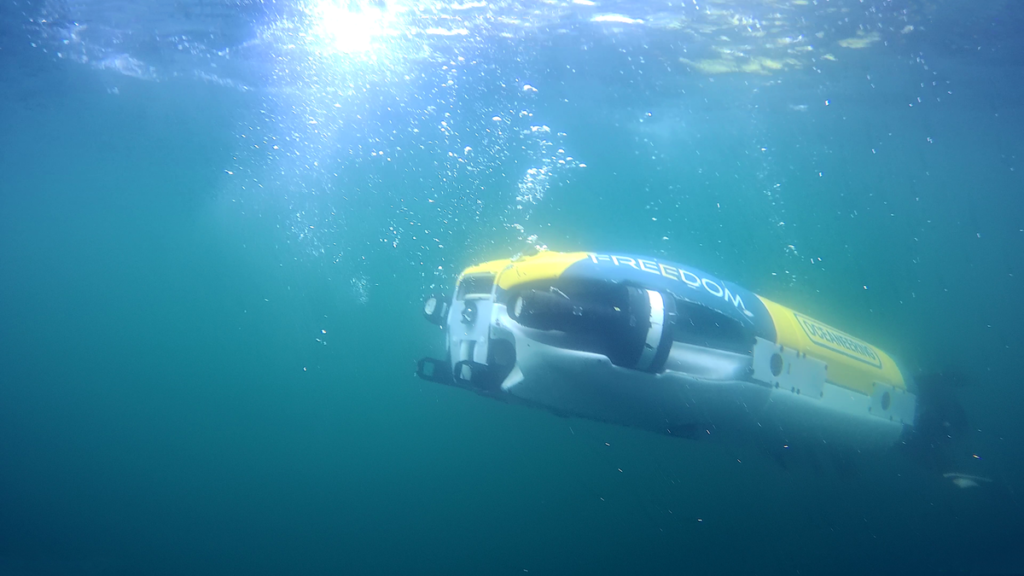
Oceaneering’s Freedom AUV in action during a pipeline inspection pilot—demonstrating low-altitude tracking and high-resolution sensor data capture over subsea lines.
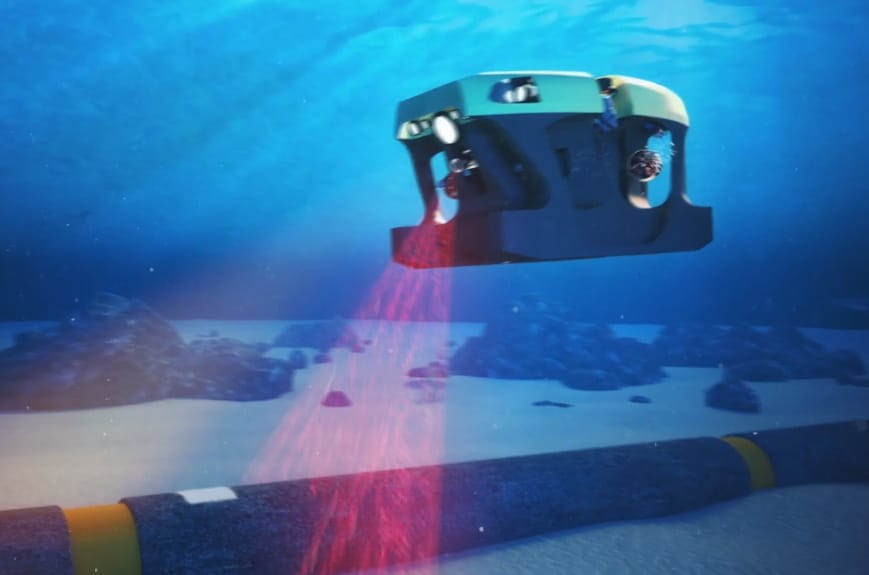
Advanced AUV equipped with laser and sonar scanning a subsea pipeline—highlighting precise detection of features like burial status and anomalies.
Key Advantages in 2026
- Speed & Coverage: AUVs survey up to six times faster than ROVs, covering 100+ km per mission with less vessel time.
- Cost & Safety: Reduced personnel offshore, smaller support vessels, and lower emissions—aligning with energy transition goals.
- Data Quality: Stable flight and advanced autonomy (e.g., adaptive behaviors) ensure consistent, high-fidelity results—even in deepwater or poor visibility.
- Repetitive Tasks: Ideal for routine integrity monitoring in large networks, with resident AUVs (dockable for extended ops) emerging as a game-changer.
Real-world examples include Oceaneering’s Freedom AUV pilot for TotalEnergies (over 120 km inspected in one go) and GEO Ocean’s AUV campaigns identifying hundreds of free spans.
The Future for Subsea ProsAs HPHT assets age and transition pressures mount, AUVs offer a scalable solution for proactive pipeline integrity reducing risks and extending field life. From my Texas A&M subsea background, the integration of AI tracking, cloud processing, and hybrid sensors is pushing boundaries we only dreamed of a decade ago.
What do you think—ready to shift more inspections to AUVs, or do ROVs still hold the edge for complex interventions?
Drop your experiences or questions in the comments below, share this post with your network, and let’s keep the conversation going!
Stay tuned to Offshore Pipeline Insight for more on subsea integrity, HPHT challenges, and emerging tech in offshore pipelines.
Gig ’em!#SubseaPipelines #AUVInspection #PipelineIntegrity #OffshoreEnergy #EnergyTransition #GigEm #AggieEngineers