Oil is back above $100. Traders are in town for APPEC. Singapore’s message this week is not “we have more barrels.” It is “we have the pipes, tanks, ships, insurers and desks that let barrels move when the usual route does not.
”Deck: Hormuz flows collapsed earlier this year. The city-state is selling optionality — storage, bunkers, paper and physical — as the product the region can actually buy.
By Oko
Founder, Offshore Pipeline Insight
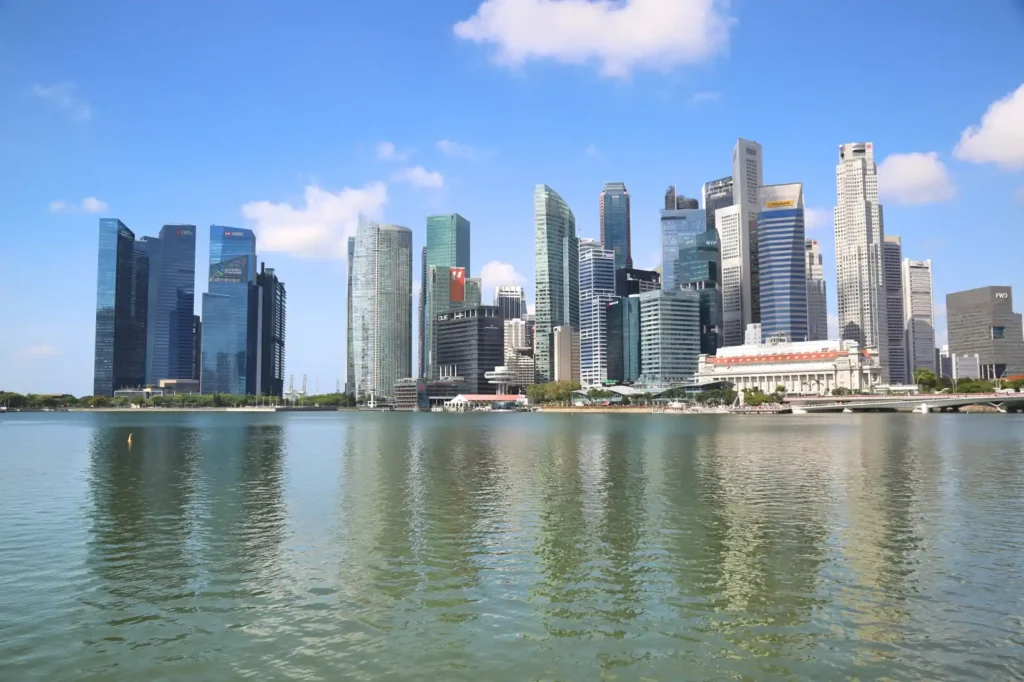
Marina Bay is where the paper trades. Jurong Island is where the molecules sit. This week both rooms were talking about the same choke point.
Brent crossed $100 for a second straight session on 10 September after Iran claimed attacks on vessels trying to pass the Strait of Hormuz. The Straits Times Index fell 0.7%. That is the market tape. The policy tape was written two days earlier at the Asia Pacific Petroleum Conference. Minister of State Gan Siow Huang told the industry the next shock will not be solved by a strategic reserve alone.
Hormuz used to move about 20 million barrels a day. Between March and May that fell to about 2.7 million. LNG through the strait effectively stopped for a stretch. ASEAN still takes more than half its crude from the Middle East. A full closure, she said, could hit on the order of 28% of the region’s final oil use.
Her test for companies was blunt: not “can we diversify,” but “where is extra resilience worth paying for?”
Singapore’s answer is the stack it already owns. More than 100 energy and chemical firms sit on Jurong Island beside storage and logistics. The Jurong Rock Caverns hold about 9 million barrels of commercial hydrocarbon storage. ADNOC has a regional trading base here.
Petrobras uses the city to reach Asian refiners. Bharat Petroleum opened its first overseas trading office here. Singapore supplies about 26% of Australia’s refined products and about a third of New Zealand’s refined barrel.During the recent interruptions it worked those corridors under existing trade arrangements. The physical market has been tight for months. Onshore product stocks fell to a 13-year low in mid-June, around 34.4 million barrels, with residual fuel the main
drain. Inventories later rebuilt, but VLSFO east of Philippines officials say Singapore is among five ASEAN states interested in a regional oil stockpile study due by November. That would put the hub in the politics of shared barrels, not only the trading of other people’s barrels.
What it means:
Singapore does not produce crude. It prices, stores, blends, bunkers and reroutes it. In a Hormuz year that is a sovereign capability.
Gas, pipe and the second terminalEight New LNG Bunker Licences — and a Second Terminal on the Way
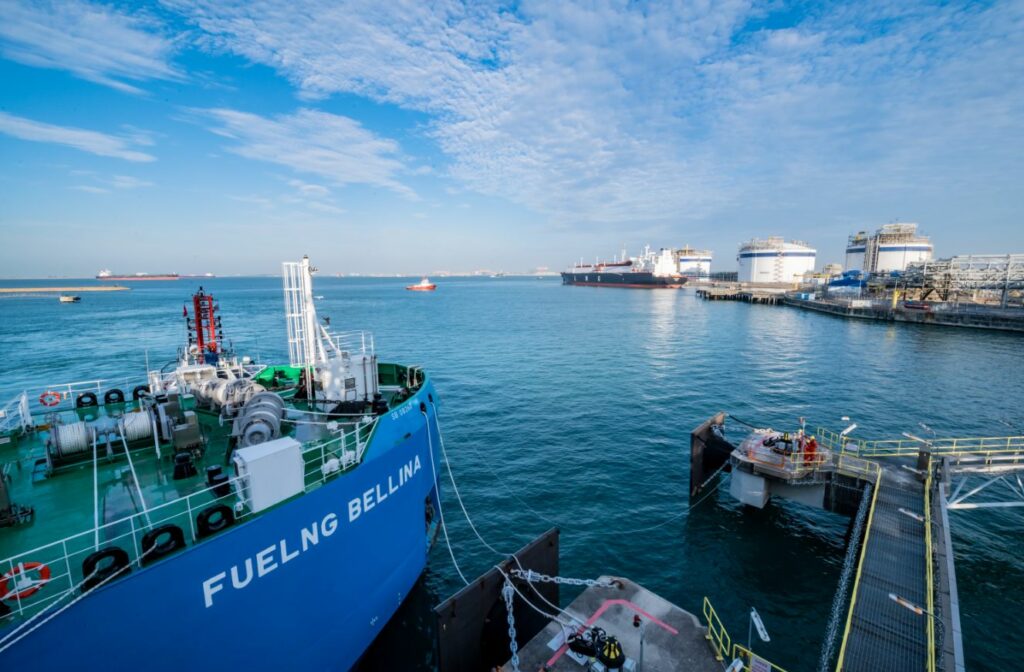
FueLNG at the rail, tanks on the skyline. LNG bunkering in Singapore used to be a three-licence club. It is now a crowded market with rules attached.
he world’s largest bunkering port is no longer treating LNG as a pilot. On 1 September eight new five-year licences took effect. In the east, a second import terminal is being built so gas does not depend on one jetty and one set of tanks. More suppliers at the ship’s rail. More steel into the national gas grid. Singapore is laying the midstream for a multi-fuel harbour.
MPA awarded licences, valid to 31 August 2031, to:
Aramco Trading Singapore; Equatorial Marine Fuel Management Services; ExxonMobil Asia Pacific; PetroChina International (Singapore); Shell Eastern Trading; Sinopec Fuel Oil (Singapore); the TotalEnergies Gas & Power Asia–Sembcorp Fuels joint venture; and Vitol Bunkers. Existing licences run to year-end. Before this round the port had three LNG bunker licensees: FueLNG, Pavilion Gas and TotalEnergies Marine Fuels.
Licensees must cover the whole chain: supply, storage, transfer and delivery. MPA also scored methane-slip control and the ability to move lower-carbon methane — biomethane and e-methane. TR56, the old technical reference, was due to become a full Singapore Standard in August, covering safety, custody transfer, procedures and crew competence.
The volumes justify the paper. Total marine-fuel sales hit a record 56.77 million tonnes in 2025. Alternative fuels rose 44% to 1.95 million tonnes. LNG bunker sales in the first half of 2026 were about.318,300 tonnes, up roughly 30% year on year. Equatorial has a 20,000 m³ bunker vessel on order. Shell has two 18,900 m³Purus newbuildings due in 2028. Methanol-capable tankers are already lining up at the same docks. Ammonia standards are next.
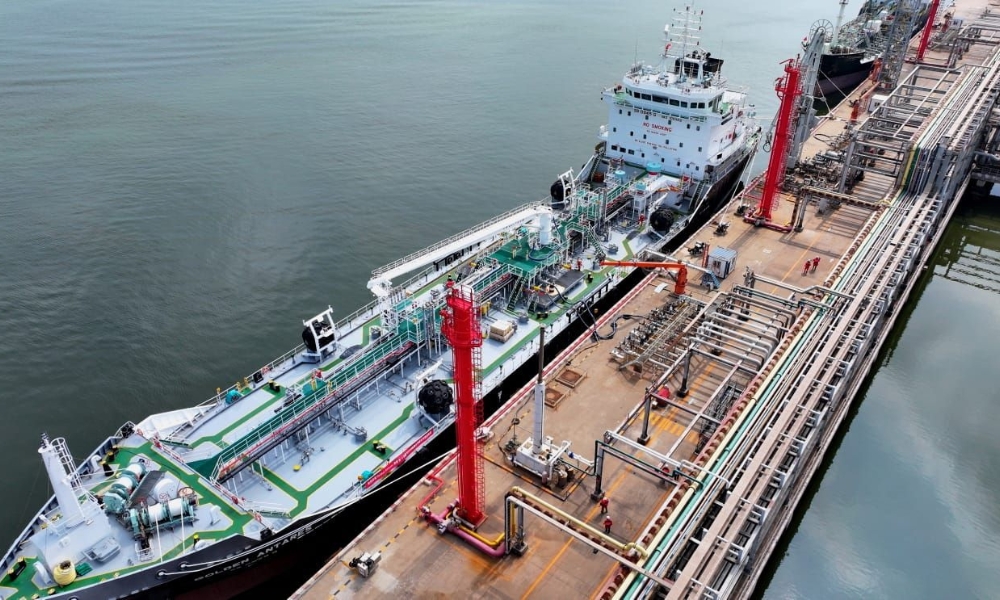
A bunker tanker on the pipe rack. Conventional fuel oil still dominates the 56-million-tonne book. LNG, methanol and later ammonia are how Singapore keeps that book when carbon rules tighten.
The power system needs a second door for molecules. SLNG 2 is planned as an FSRU-based import terminal. MOL is building a roughly 204,000 m³ FSRU at Hanwha Ocean’s Geoje yard, about $413 million, keel laid in May 2026, delivery targeted by October 2027. SLNG awarded onshore connecting works — process area, jetty, pipelines into the national gas grid — to China Communications Construction Company (Singapore), with groundbreaking in late March 2026. The unit is meant to moor at Jurong Port and tie into the grid by 2030, lifting combined throughput with the existing Jurong Island terminal toward 15 million tonnes a year.
Pipeline gas from Indonesia has been a less reliable story. A planned Sembcorp–Mako contract was terminated in 2025 on regulatory issues. LNG is the buffer until 2030 while the power sector tries to decarbonise. Cross-border electrons are part of the same hedge: Sembcorp has conditional approval to import about 300 MW of renewable power from a Johor floating-solar and battery scheme aimed at 2029.
What it means for a pipeline reader: The interesting steel in Singapore this year is not a cross-island crude trunkline. It is bunker hoses, FSRU risers and the short, high-spec lines that put gas into the national grid.
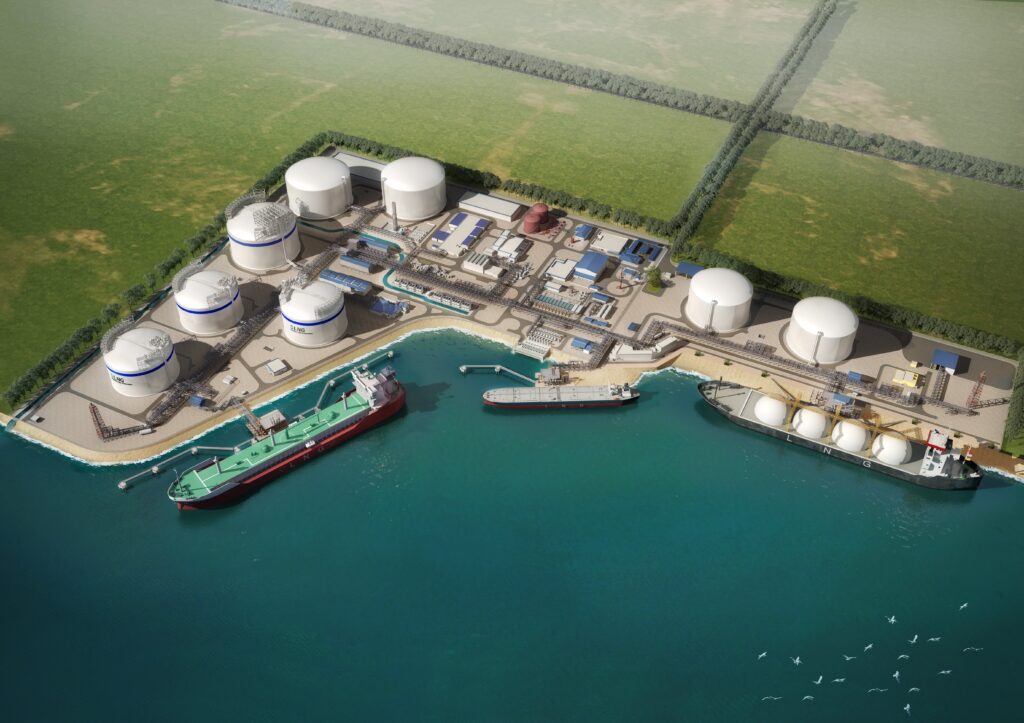
How an LNG terminal is meant to look: tanks, jetties, pipework, ships. SLNG 2 adds an FSRU and a new grid tie so the island is not one-terminal deep.
Jurong, Bukom and the next island Jurong Is Full. Singapore Wants Another Energy Island.
Prime Minister Lawrence Wong used the National Day Rally to float a western island — a Jurong-style reclamation tying together outer islands that could include Pulau Bukom, Pulau Semakau and Pulau Sudong. his week ministers said the profile, land use and timeline are not fixed. The reason for the idea is fixed: Jurong Island is about 3,000 hectares, and less than a third is still free.The leftover land is already booked for specialty chemicals, sustainable materials, new energy and low-carbon data centres
Deck: Refining, hydrogen-ready power, CCS studies and a second industrial island. Singapore is building the next 50 years of midstream on land it does not yet have. Singapore’s refining system is still three large sites: ExxonMobil on Jurong Island, Shell’s heritage plant on Pulau Bukom, and Singapore Refining Company. The corporate name that keeps recurring in 2026 deal flow is Aster, the Chandra Asri–Glencore platform that now sits on former Shell downstream pieces.
It is lifting naphtha-cracker utilisation, taking a Changi Airport fuel-infrastructure stake, putting Sembcorp into 20% of its clean-power unit as sole gas supplier, and studying a 100,000-tonne-a-year ethanol-to-SAF plant with Keppel. A separate Bukom project with Aether Fuels would turn industrial waste gas into SAF.
New power on Jurong is being specified as hydrogen-ready. Since 2024, new and repowered gas plants must be able to burn at least 30% hydrogen by volume. The build list through 2029 includes Meranti Power’s 682 MW fast-start open-cycle units, Keppel Sakra Cogen and Sembcorp Cogen at 600 MW each, YTL PowerSeraya at 600 MW, and PacificLight’s 670 MW Mitsubishi JAC plant aimed at 2029 with battery storage. Keppel Sakra is already running as a 30% hydrogen-compatible CCGT.
A Keppel-led consortium is also in the next phase of a low- or zero-carbon ammonia scheme for power and bunkering. Carbon has to go somewhere. The state target is at least 2 million tonnes of capture by 2030. Shell–ExxonMobil’s S-Hub consortium is studying a cross-border CCS project of 2.5 million tonnes a year. Air Liquide and Aster are looking at autothermal reforming with capture, feeding hydrogen into existing