Offshore Pipeline Insight
Feature | September 8 2026
The Seabed Is Busy Again… By Oko
Founder, Offshore Pipeline Insight
From India’s western shelf to the ultra-deep waters off West Africa and Brazil, subsea pipelines are no longer a supporting act. They are the system that decides whether a field gets developed, how far a tieback can stretch, and how quickly new gas reaches an LNG plant. In 2026 the work is technical, competitive, and global.
The story on the water this year is not a simple boom. It is a measured rebuild of infrastructure: replacement programmes on ageing fields, longer and hotter flow-lines on new deepwater hubs, and a quiet race to make electrically heated pipelines cheaper than the last generation of pipe-in-pipe.
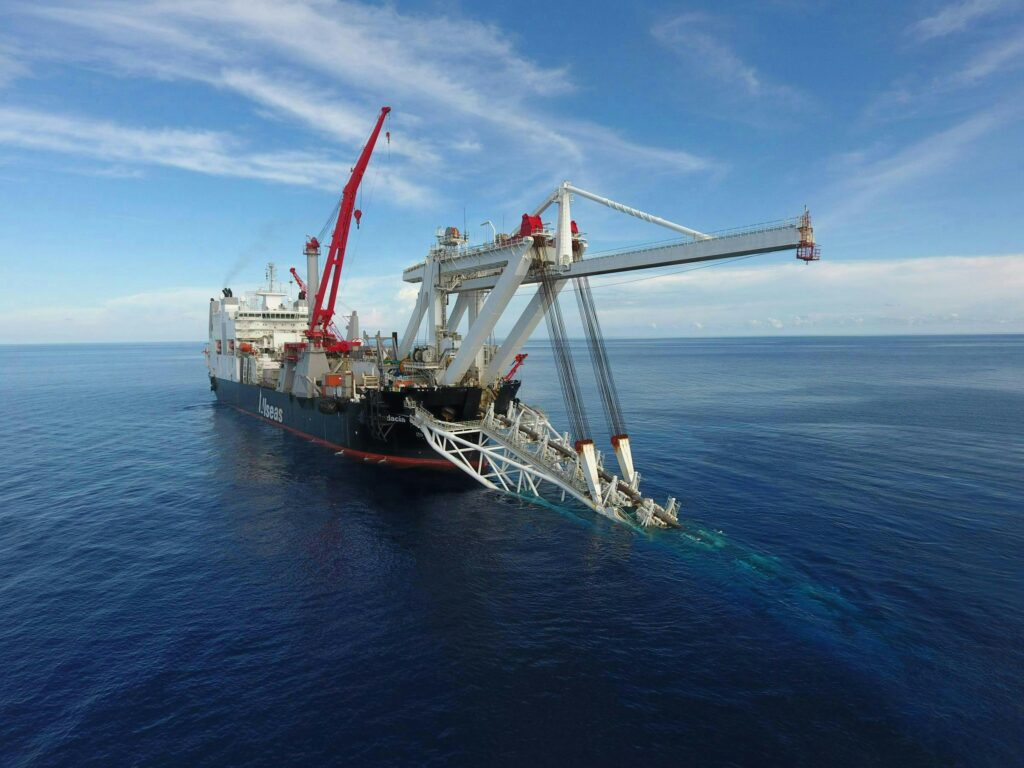
An Allseas pipelay vessel working in open water — the kind of spread now booked across India, West Africa, the Gulf of Mexico and the North Sea.
Why pipelines still decide the project
A platform without a line is just steel in the water. Export lines move oil and gas to shore or to an FPSO. Infield lines connect wells to manifolds. Umbilicals and heated flow-lines keep the product moving when the seabed is cold enough to form hydrates or wax.
Operators have learned the expensive lesson of the last decade: a new host platform is often harder to justify than a longer tieback. That is why so much 2026 activity is SURF work — subsea umbilicals, risers and flowlines — rather than giant new topsides. Market estimates put the global offshore pipeline business in the mid-teens of billions of dollars this year, with forecasts pointing toward the low-to-mid twenties by 2030 as deepwater and LNG export systems keep adding kilometres. The work is also getting deeper. Lines past 2,000 metres are no longer exceptional. BP’s Greater Tortue Ahmeyim campaign off Mauritania and Senegal put 16-inch export pipe into water approaching 2,400–2,700 metres. Brazil’s pre-salt, the U.S. Gulf, the eastern Mediterranean and West Africa are all pulling the same way: more pipe, more CRA cladding, more precise landing boxes on the seabed.
How the pipe actually goes down
Four methods still dominate, and every project engineer lives with the trade-offs.
S-lay is the workhorse. Pipe is welded on a firing line, coated at the field joint, and eased over a stinger in an S-curve to the seabed. It is fast in shallow and moderate depths.
J-lay hangs the pipe almost vertically. It handles high tension and deep water better, at the cost of slower joint rates.
Reel-lay welds long stalks onshore, spools them onto a giant reel, and unspools them at sea. Fewer offshore welds, faster lay — ideal for many rigid flowlines.
Tow-out is rarer, used when a bundle or unusual configuration is assembled inshore and pulled to location.
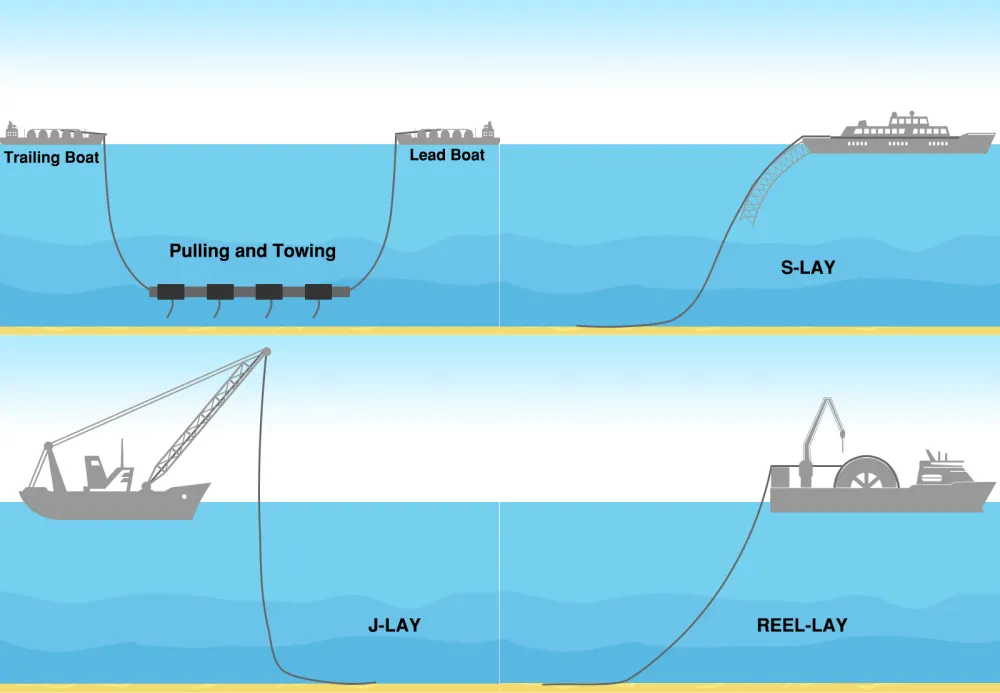
The four classic installation methods. Depth, pipe diameter, weather window and vessel availability decide which one wins.On the vessel, the work looks industrial and unforgiving. Welders on the firing line join coated joints under tight ovality and NDT limits. A bad weld is not a delay. It is a cut-out in a swell.
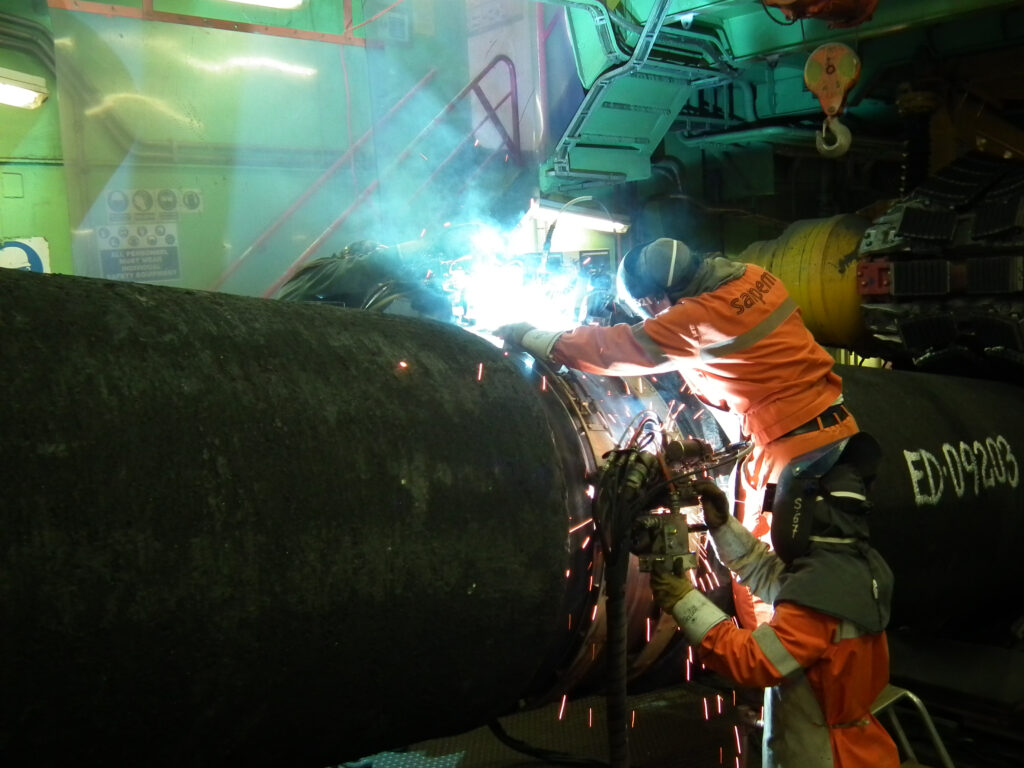
Firing-line welding remains the heartbeat of S-lay. Quality here is what the pipeline lives with for 25 to 40 years.From the stinger, the pipe disappears into the water.
Tensioners hold the catenary. Survey spreads watch the touchdown point. In shallow water the line may be trenched or rock-dumped. In deep water it often sits on the seabed, with spans corrected later by ROV.
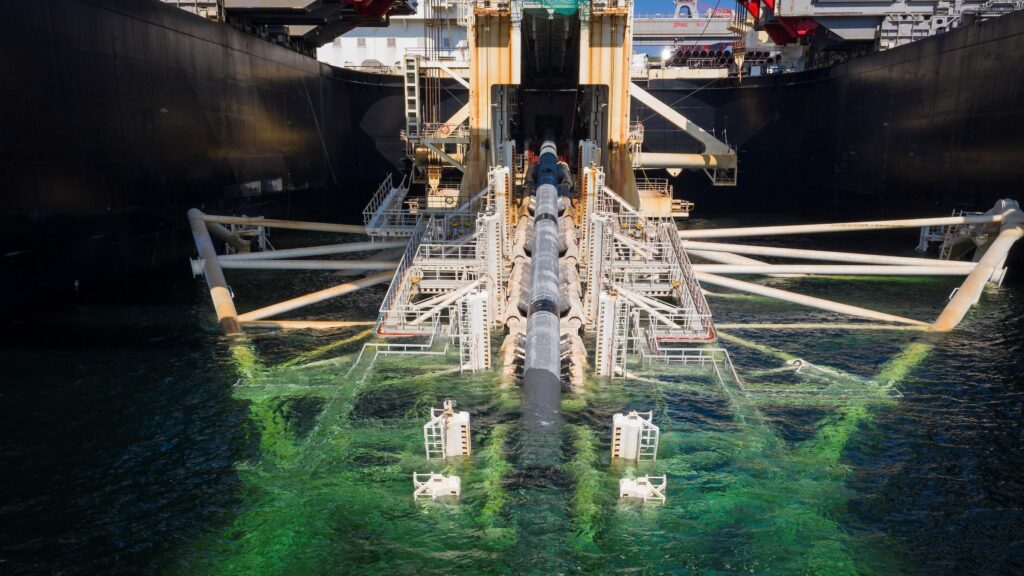
Pipe leaving the vessel and entering the water — the moment design assumptions meet real hydrodynamics.
The contracts that matter this month
India — ONGC PRP-IX. Lamprell has been awarded ONGC’s Pipeline Replacement Project covering about 285 km of subsea lines across Mumbai High, Neelam-Heera and Bassein and Satellite fields, plus associated topside modifications. This is brownfield work at scale: replace ageing carbon-steel systems, keep production online, and modernise a basin that still anchors India’s offshore output. For contractors, India is again a serious pipelay market, not only a platform-refurbishment market.
West Africa — GTA and LNG feed. Allseas’ Pioneering Spirit completed infield pipelay on BP’s Greater Tortue Ahmeyim project, including 16-inch export lines and CRA infield lines. The vessel used a purpose-built J-mode frame to land pipe in a two-metre target box in ultra-deep water. That is the standard now expected on LNG-linked developments off Mauritania, Senegal and Mozambique.
Canada — Prince Rupert Gas Transmission. Western LNG awarded Allseas the critical subsea section of PRGT: roughly 50 km of 36- and 48-inch concrete-weight-coated pipe linking the onshore system to a planned floating LNG facility on Pearse Island. Shore crossings, pull-ins and nearshore work in remote British Columbia waters make this as much a marine-civil job as a pipelay job. Installation is planned later in the decade.
Gulf, Mediterranean, Southeast Asia. McDermott’s sizeable subsea award on Eni’s Cronos field offshore Cyprus, Subsea7’s replacement campaign for Brunei Shell Petroleum, Aramco flexible-pipeline tenders at Berri and Marjan, and Allseas scopes on Trion (Mexico), Sparta export lines (U.S. Gulf) and Búzios-10 (Brazil) show how spread the order book is. No single basin owns 2026.
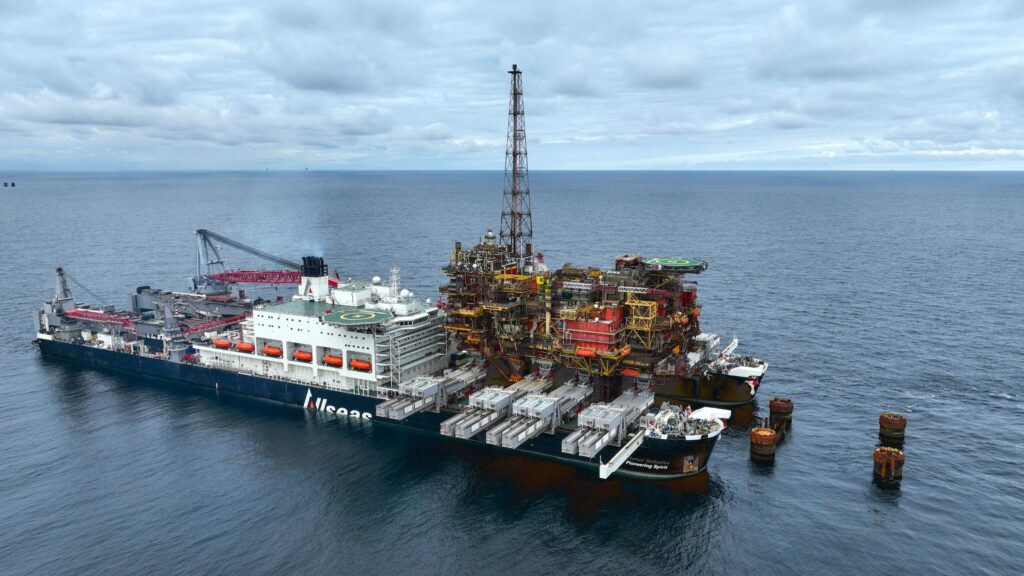
Pioneering Spirit — part pipelay machine, part heavy-lift giant — has become a shorthand for campaigns that mix export lines, infield systems and large structures.
The technology bet: heat the line, not the whole project
The most interesting engineering story of the year is not a vessel. It is FlowHeat, a joint industry project involving TotalEnergies, Equinor, Aker BP, DeepOcean, Tenaris and LS Cable & System.
Deepwater tiebacks fail commercially when wax and hydrates force pipe-in-pipe, chemical injection or bulky integrated heating. FlowHeat separates pipeline installation from heating-cable installation. Power cables can go in after the line is laid, or be integrated into a reeled pipe.
The consortium claims manufacturing and installation cost cuts of up to 35 percent and carbon reductions around 30 percent, with repairable cables, fibre monitoring, and deployment by smaller ROVs. Design range: tiebacks of 30 km, potentially 50 km, in water to 3,000 metres. More than 300 electrically heated flowline opportunities have been flagged by 2030 across Norway, Brazil, the U.S. and Africa. If it qualifies at full scale, the map of “stranded” satellites changes. Fields that were too far or too cold from an existing host become candidates again.
Integrity: the unglamorous half of the business
New kilometres get the press. Old kilometres keep the lawyers busy. Ageing networks in the North Sea, Gulf of Mexico, India and Southeast Asia need inspection, span correction, anode replacement and, increasingly, full-line replacement like PRP-IX.
ROVs and AUVs now do the walking. High-speed inspection vehicles map coating damage, freespans and debris. Operators want digital twins of the line, not a PDF from last year’s campaign.
A DeepOcean inspection vehicle going over the side. Integrity work is where brownfield operators spend when they are not laying new pipe.Launch and recovery in a seaway is still a human operation. The vehicle is only as good as the vessel, the crane and the people on deck.
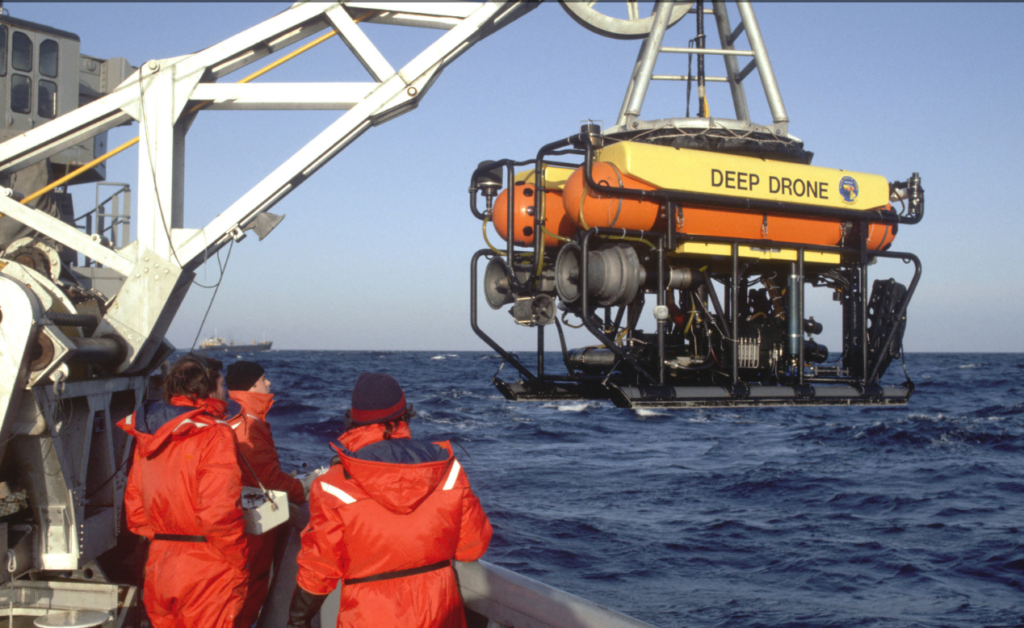
ROV deployment remains a core skill on every pipeline campaign — construction, as-laid survey and life-of-field inspection.
What readers should watch through 2027
1. Brownfield replacement in Asia. ONGC’s western offshore programme is a signal. Mature basins will keep awarding multi-hundred-kilometre packages.
2. LNG-linked export systems. GTA, Mozambique Rovuma, Canadian west-coast gas and Gulf export projects all live or die on a few critical subsea sections.
3. Longer heated tiebacks. FlowHeat and rival DEH / PiP systems will decide which satellites get sanctioned.
4. Vessel scarcity at the top end. There are only a handful of ships that can lay large-diameter pipe in ultra-deep water and also handle heavy structures. Day rates and schedules will stay tight.
5. Dual-use corridors. Carbon-storage lines (Porthos-type systems) and hydrogen or CO₂ pipelines are starting to sit on the same contractor spreads as oil and gas work. The weld procedure may look familiar. The product and the permit will not.
Bottom line for the industry.Offshore pipelines in 2026 are a craft business running on industrial scale. The pipe still has to be welded straight, tensioned correctly, and anded where the survey said it would land. What has changed is the purpose of many of those kilometres: keep old fields alive, stretch new ones farther from the host, and feed LNG trains that governments now treat as energy-security assets.For an audience that lives with codes, vessels and field names, the message is simple.
The seabed is booked. The interesting work is no longer only “how many kilometres.” It is which kilometres — replacement, export, or heated tieback — and whether the industry can install them cheaper, cleaner and deeper than the last cycle.