The picture is split. In the United States, policy risk is still the story: California is moving against the Trump administration and RWE over cancelled Humboldt/Canopy-type floating leases, and Dominion’s Coastal Virginia farm is generating while the bill and the calendar keep stretching. In Europe and Asia the week is about steel, cables and standardization a €1 billion EIB facility for Belgium’s energy island, UK innovation money on foundations and substations, a Taiwan floating-wind demo auction aimed at 2027, and TetraSpar towed inshore after five years in the North Sea.
Deck: The U.S. pipeline is thinner than it was three years ago. The North Sea is still trying to industrialise the next gigawatts — and cut LCOE by as much as 28% if volume holds.
By Oko Immanuel
Sept 10 2026
Founder, Offshore Pipeline Insight
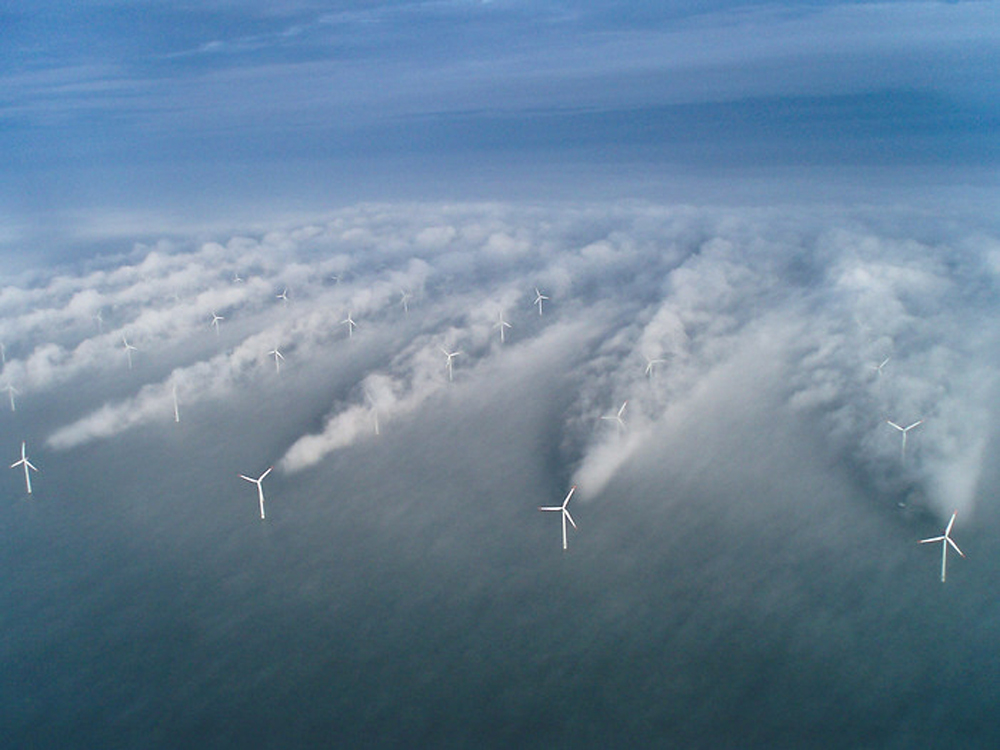
North Sea arrays already look like a factory. That is the market DNV says can still cut costs if platforms stop changing every auction.
America: leases cancelled, one farm still turning
California’s fight is now a paper trail of notices and suits. On 1 September, Attorney General Rob Bonta and the California Energy Commission sent a notice of intent to sue Interior and RWE over a $1.22 billion agreement to cancel three offshore wind leases — including Lease OCS-P 0561 in the Humboldt Wind Energy Area, held through RWE’s Canopy Offshore Wind affiliate. The site was sold in 2022 and can support up to 1.6 GW of floating capacity. The California slice of the settlement is about $121 million back to Canopy — the lease price minus bid credits that would have gone to workforce, supply chain and community benefits. The money is supposed to be reinvested in LNG and gas projects outside the state. California says that violates the Outer Continental Shelf Lands Act. A separate clock is running on Invenergy’s California buyout. Golden State Wind’s Morro Bay lease is already in court.
Five federal leases were awarded off California. Two of the central-coast floating projects have been bought out. Humboldt is the latest. The state’s argument is process as much as climate: no proper hearing, no five-year suspension path, no real coordination with the governor.The farm that is actually spinning is on the other coast.
Dominion’s 2.6 GW Coastal Virginia Offshore Wind is past 80% complete and already on the grid. As of late July, all 176 monopiles and transition pieces were in; about 31 turbines were up, with more than 450 MW installed. Two offshore substations were commissioned; the third is due by year-end. The last turbine is now aimed at end-2027, not early 2027. The capital budget sits around $11.65–11.7 billion, up nearly $300 million from April — PJM network upgrades, tariffs, and a slower install curve after weather, vessel time and harder jacking on remaining locations. Original 2020 talk was $7.8 billion. A December 2025 BOEM stop-work order over navy-radar concerns already put delay cost on the books. CVOW South remains an option, not a budget line. That is the U.S. split in one week: litigation over floating paper off California, cost growth on the one large fixed-bottom job that got far enough to generate.
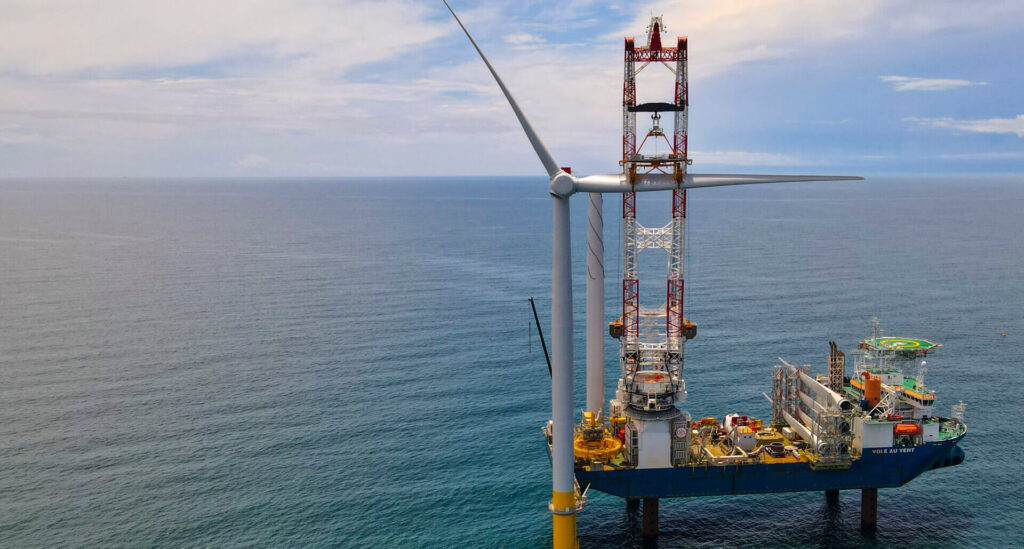
Installation vessel on a Coastal Virginia turbine. CVOW is the American exception: it is in the water. The rest of the U.S. pipeline is thinner than the 2022 lease map suggested.
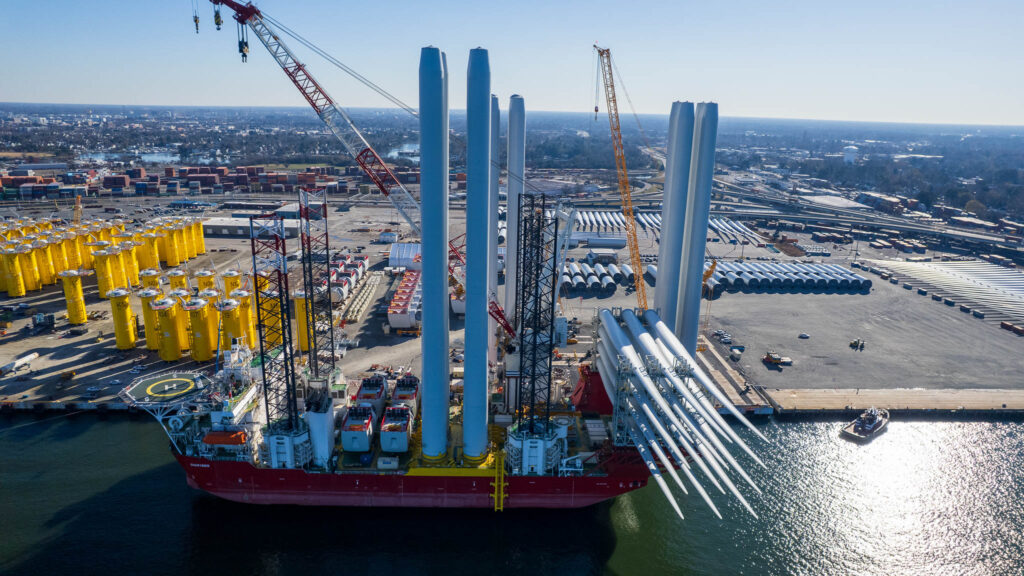
Towers, blades and yellow cans at the Virginia marine terminal. The remaining risk is not “will it work.” It is tariffs, weather days and when the 176th machine stands up.
Belgium: a billion euros for the island, not the turbinesElia Transmission Belgium signed a €1 billion green credit facility with the European Investment Bank for phase two of Princess Elisabeth Island — about 45 km off the Belgian coast. It is the EIB’s largest energy-infrastructure loan in the Benelux. Add the €650 million 2024 facility and EIB support is about €1.65 billion. The new money is for the high-voltage substation, 66 kV switching, transformers and AC connections to shore: six three-phase 220 kV cables to an onshore 220 kV station. First drawdown was around end-July. The 23rd and last foundation element is in. The island is meant to collect 3.15–3.5 GW in the Princess Elisabeth Zone and open a path to a UK interconnector. First parks would tie in from 2031. Belgium today has about 2.26 GW offshore. The zone could more than double that — if the delayed tender framework holds.
The project has a Belgian reputation for cost growth. The EIB and Elia still call the loan an endorsement, not a bailout. For a pipeline desk the point is the midstream: the island is a collector so you do not pull a dedicated export cable from every farm.
How Princess Elisabeth is meant to look: a concrete box in the North Sea that turns many array cables into a few fat export lines. That is grid, not generation.
UK: small cheques on the bits that scale
The Offshore Wind Growth Partnership put about £1 million across seven firms — Acuity Robotics, Akselos, Crondall Energy, Fathom, Quoceant, Sperra Seaworks and T12 Engineering — aimed at near-market kit in foundations/substructures and substations/electrical systems. Industry backing sits with OWIC, Equinor and SSE. Separate Scottish money — more than £778,000 — is going into a FEED study for a BW Ideol concrete-floater factory at Ardersier, sized in principle for one foundation every 12 days. That is not a farm FID. It is the industrial layer DNV says the North Sea still lacks.
Taiwan: a floating demo auction, not a GW round
Taipei’s Energy Administration briefed a floating demonstration selection: in principle two sites, a possible third, each with 6–12 floaters and about 100–200 MW. Grid connection by end-2032, with a one-year slip if all platforms are in or half are connected by that date. Scoring: technical 45, financial 40, sustainability 15, pass mark 70. Rules are due in late 2026; applications through mid-2027; results as early as Q3 2027. A draft feed-in tariff is promised by year-end. This is how Asia is treating floating: prove the kit in tens-to-low-hundreds of megawatts before talking about a commercial fleet.
TetraSpar: the demo that finished the loop
After nearly five years at Norway’s METCentre off Karmøy, the TetraSpar Demonstrator was disconnected and towed inshore to Hanøytangen near Bergen. The 3.6 MW Siemens Gamesa machine sat on Stiesdal’s modular steel floater in 200 metres of water. Partners: Stiesdal Offshore, RWE, TEPCO Renewable Power. Reported numbers: 98% availability, 51.4% lifetime capacity factor, about 70 million kWh into the Norwegian grid. The campaign covered quayside assembly without welding, tow, hook-up, deepwater operations and now decommissioning. The export cable went into wet storage at 210 metres so the berth can take the next concept. That is a complete floating-wind life cycle in one unit — the data set California no longer gets from Humboldt if the buyout stands.
The cost argument:
stop redesigning the machineDNV’s joint-industry work with eight European supply-chain firms models North Sea LCOE from 2025 to 2050 on a roughly 15 MW monopile reference. Business-as-usual with short production runs: about 5% lower LCOE by 2035. Longer runs on the same platform: about 14% by 2035 and 25% by 2050. High-volume case: about 19% by 2035 and 28% by 2050. Most of the saving is capex — turbines and development — plus installation and substructures. The political condition is a predictable pipeline. Stop-start auctions are exactly what the U.S. is now advertising. Installations outside China are still expected to have a strong 2026. The geography of that strength is Europe and parts of Asia, not a rebuilt U.S. lease book.
How to read the split
The United States is generating one large farm and litigating the next ones. CVOW proves fixed-bottom can be built off Virginia. Humboldt and Morro Bay show floating paper can be bought back and steered into gas.
Europe is spending on the collector, not only the turbine. Princess Elisabeth is six fat AC cables and a concrete island. That is the same logic as a pipeline hub: aggregate, then export.
Floating is graduating from demo to small auctions. TetraSpar finished. Taiwan will pick two or three sites. California may lose the sites it already sold.
Cost falls if the design stops moving. DNV’s 28% is a volume story. Volume needs leases that stay leased.For this desk the cable is the cousin of the pipe. Array lines, export systems, island substations and dynamic cables on floaters are the midstream of offshore wind. This week America argued over who owns the lease. The North Sea wrote a loan for the hub that makes the next farms cheaper to connect.
Published by Offshore Pipeline Insight.